
Federal income tax deductions reduce the amount of income subject to federal income tax. The deductions available to you depend on your filing status, income, eligible expenses, and applicable IRS rules.
This guide covers the main federal income tax deductions for 2026, including standard, itemized, above-the-line, and business deductions. It also explains new tax provisions, eligibility requirements, and how to claim the deductions that apply to your situation.
What Are Federal Income Tax Deductions?
Federal income tax deductions are amounts eligible taxpayers can subtract from income when calculating taxable income. Each deduction has specific eligibility requirements, limits, and reporting rules.
The IRS explains deduction and taxable-income rules in its federal income tax guidance.
How Federal Income Tax Deductions Work
Your federal income tax calculation starts with gross income. Eligible adjustments reduce gross income to adjusted gross income (AGI), then applicable deductions calculate taxable income.
For example, a $5,000 deduction could reduce your taxable income from $60,000 to $55,000. The actual tax savings depend on your tax bracket and the rules governing the deduction.
Federal Tax Deductions vs. Tax Credits
Tax deductions and tax credits affect your tax liability differently.
- Tax deductions reduce taxable income.
- Tax credits directly reduce the tax you owe, subject to applicable rules.
Some credits are refundable, meaning eligible taxpayers may receive a refund even if the credit exceeds their tax liability. Nonrefundable credits generally cannot reduce tax liability below zero.
What Are the Main Types of Federal Income Tax Deductions in 2026?
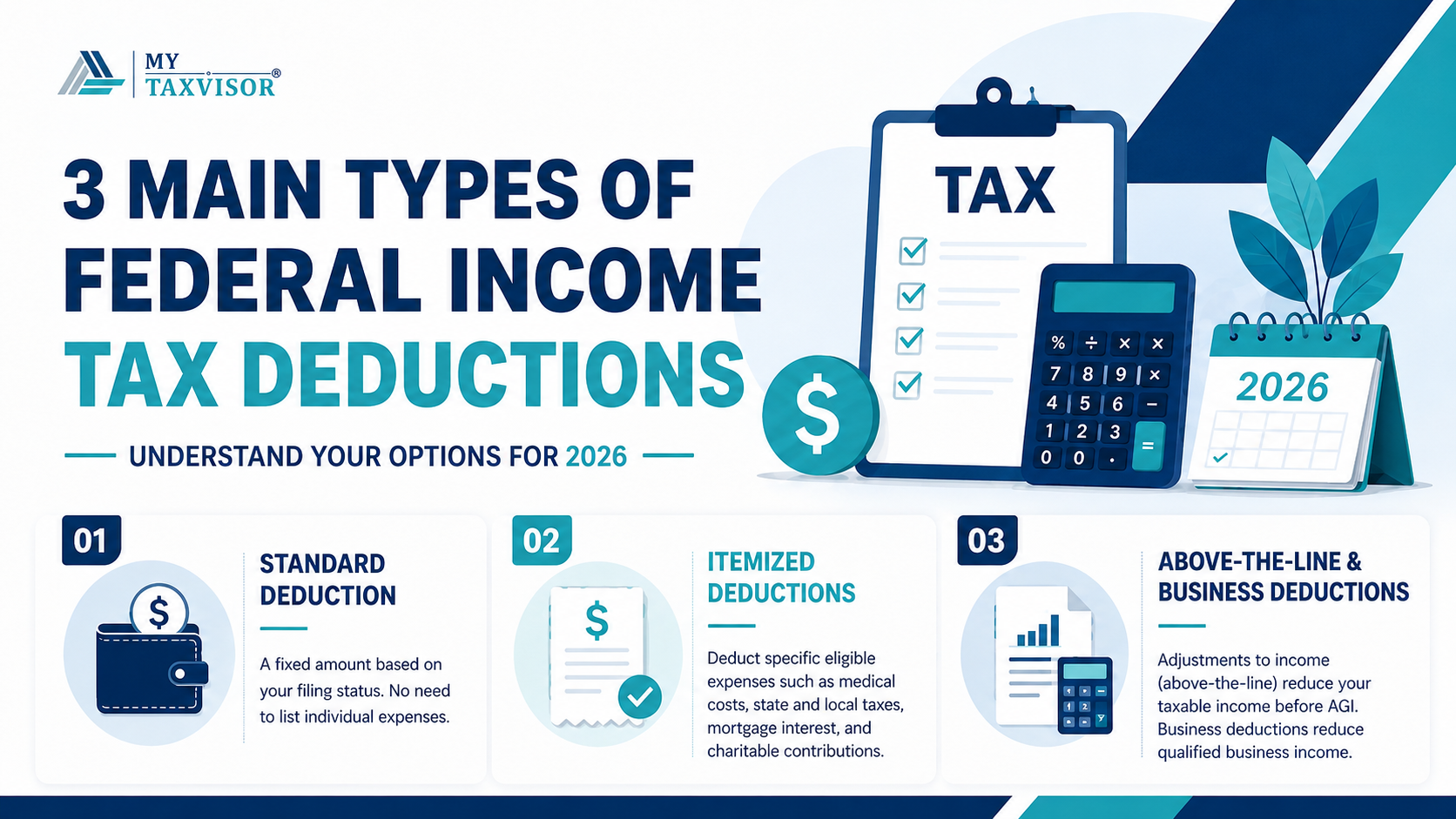
Federal deductions fall into several categories. The main differences concern how each deduction is calculated and whether the taxpayer must itemize.
Standard Deduction
The standard deduction is a fixed amount eligible taxpayers can subtract from income without listing individual deductible expenses. The amount depends on filing status, with additional amounts available to qualifying taxpayers who are age 65 or older or legally blind.
Itemized Deductions
Itemized deductions allow taxpayers to claim specific eligible expenses instead of taking the standard deduction. They are generally reported on Schedule A (Form 1040).
Common categories include qualifying medical expenses, state and local taxes, mortgage interest, and charitable contributions.
Above-the-Line and Business Deductions
Above-the-line deductions, also called adjustments to income, reduce income before AGI is calculated. Examples include qualifying traditional IRA contributions, student loan interest, and self-employed health insurance premiums.
Business deductions follow separate rules. Eligible business owners and self-employed individuals may deduct qualifying operating expenses when calculating business income.
2026 Standard Deduction Amounts by Filing Status
The standard deduction reduces taxable income by a fixed amount determined by filing status. The 2026 amounts are:
| Filing Status | 2026 Standard Deduction |
| Single | $16,100 |
| Married Filing Separately | $16,100 |
| Married Filing Jointly | $32,200 |
| Head of Household | $24,150 |
| Qualifying Surviving Spouse | $32,200 |
Source: IRS Publication 505 for 2026.
These amounts apply to income earned during the 2026 tax year, from January 1 through December 31. Taxpayers will generally file their 2026 federal income tax returns in 2027.
Who Qualifies for the Standard Deduction?
Most individual taxpayers qualify, subject to certain restrictions. For example, married taxpayers filing separately generally cannot take the standard deduction if their spouse itemizes. Special rules also apply to individuals who can be claimed as dependents.
Additional Standard Deduction for Age or Blindness
Taxpayers who are age 65 or older or legally blind may qualify for an additional standard deduction.
For 2026, the additional amount is generally:
- $1,650 for each qualifying condition for married taxpayers and qualifying surviving spouses.
- $2,050 for each qualifying condition for unmarried taxpayers who are not qualifying surviving spouses.
This additional standard deduction is separate from the enhanced senior deduction introduced under 2025 tax legislation. Eligible taxpayers may qualify for both, subject to the respective requirements.
What Itemized Deductions Can You Claim in 2026?
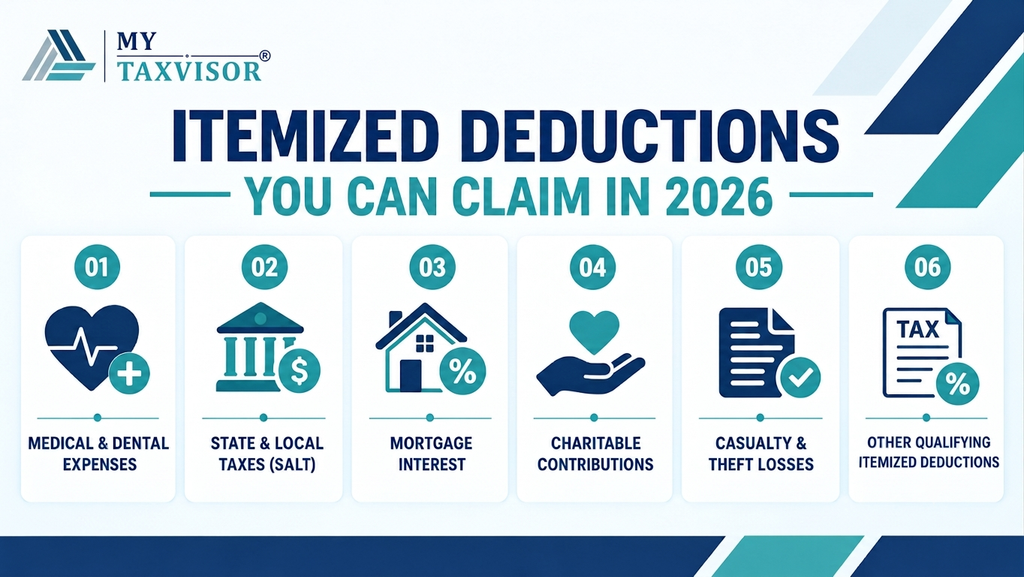
Itemized deductions cover specific eligible expenses that taxpayers may deduct instead of taking the standard deduction. The allowable amount depends on the expense category, documentation, income, and applicable limitations.
Compare your allowable itemized deductions with the standard deduction to determine which option provides the greater deduction.
Medical and Dental Expenses
Taxpayers who itemize may deduct qualifying unreimbursed medical and dental expenses, but only the portion exceeding 7.5% of AGI.
Eligible expenses may include qualifying medical treatment, prescription medications, dental care, and certain medical equipment. Reimbursed expenses generally cannot be deducted.
Example: If your AGI is $80,000, the 7.5% threshold is $6,000. If you have $8,000 in eligible unreimbursed medical and dental expenses, $2,000 may be deductible, subject to applicable rules.
State and Local Taxes (SALT)
The state and local tax deduction, commonly called the SALT deduction, covers certain state and local taxes paid by eligible itemizers.
Qualifying taxes may include:
- State and local income taxes or general sales taxes, but not both.
- Eligible real estate taxes.
- Eligible personal property taxes.
For 2026, the combined SALT deduction limit is generally $40,400, or $20,200 for married taxpayers filing separately. Income-based restrictions may reduce the deduction, potentially to $10,000, or $5,000 for married taxpayers filing separately.
Mortgage Interest
Eligible homeowners may deduct qualifying mortgage interest when they itemize. Eligibility depends on the property, how the loan proceeds were used, when the debt was incurred, and applicable debt limits.
The deduction may cover qualifying interest on a main home or second home. Mortgage principal repayments are not deductible as mortgage interest. Interest on home equity debt generally does not qualify when the funds were used for personal expenses rather than to buy, build, or substantially improve the home securing the loan.
Charitable Contributions
Taxpayers who itemize may deduct eligible contributions to qualifying charitable organizations, subject to documentation requirements and applicable limits. Cash contributions generally require supporting records, such as bank records or written acknowledgment from the organization.
2026 rule change: Itemizers generally can deduct only qualifying charitable contributions exceeding 0.5% of AGI, subject to other limitations.
Eligible taxpayers who take the standard deduction may also claim a separate deduction for certain cash contributions to qualifying charitable organizations. For 2026, the maximum is generally $1,000 for eligible individual filers and $2,000 for married couples filing jointly.
Casualty and Theft Losses
Personal casualty losses are deductible only when specific requirements are met. For 2026, qualifying losses may include losses associated with federally declared disasters and certain state-declared disasters.
The deductible amount depends on the nature of the loss, insurance reimbursements, and applicable limitations. Different rules apply to business and income-producing property.
Other Qualifying Itemized Deductions
Some taxpayers may qualify for additional deductions reported on Schedule A.
For 2026, gambling losses are generally deductible only up to the lesser of 90% of gambling losses or gambling winnings. Recordkeeping and other restrictions apply.
What Above-the-Line Deductions Can You Claim in 2026?
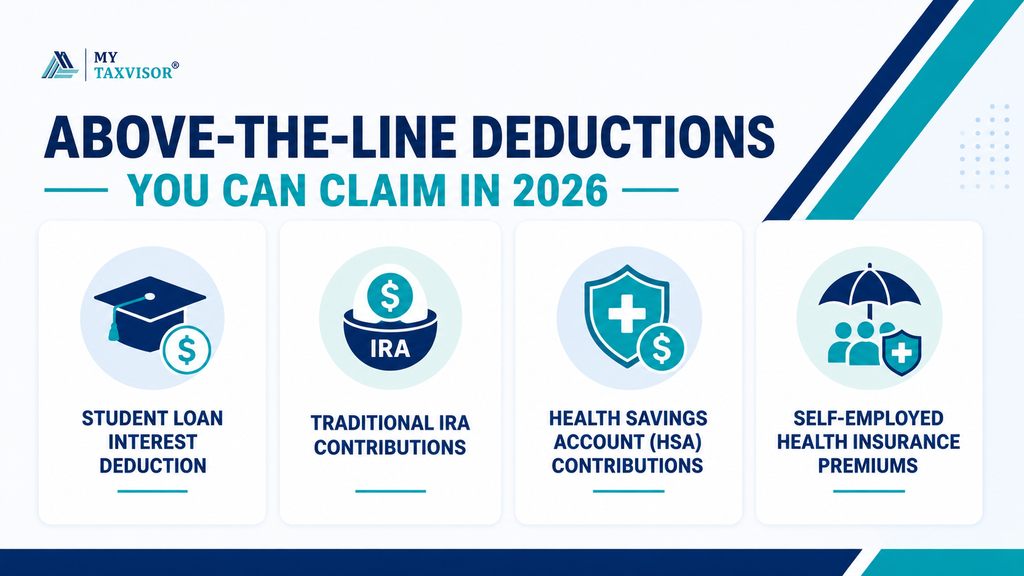
Above-the-line deductions reduce income before AGI is calculated. Eligible taxpayers can generally claim them whether they take the standard deduction or itemize, subject to individual requirements and income limits.
Student Loan Interest Deduction
Eligible taxpayers may deduct qualifying interest paid on student loans used for qualified higher education expenses. Income limits, filing status restrictions, and other eligibility requirements apply.
The deduction covers qualifying interest, not loan principal. You generally cannot claim it if someone else can claim you as a dependent or your filing status makes you ineligible.
Traditional IRA Contributions
Contributions to a traditional individual retirement account (IRA) may be deductible depending on your income, filing status, and access to a workplace retirement plan.
Participation in an employer-sponsored retirement plan may restrict the deduction at certain income levels. Contribution limits also apply. Roth IRA contributions are not deductible.
Health Savings Account (HSA) Contributions
Eligible individuals with a qualifying high-deductible health plan may deduct eligible contributions to a health savings account (HSA), subject to annual limits and other requirements.
Employer contributions are generally excluded from the employee’s income and cannot be deducted again by the employee.
Self-Employed Health Insurance Premiums
Self-employed individuals may qualify to deduct premiums for eligible medical, dental, and qualifying long-term care insurance covering themselves, their spouse, and eligible dependents.
The deduction is subject to restrictions involving employer-subsidized coverage eligibility and earned income from the relevant business.
What Business Tax Deductions Are Available in 2026?
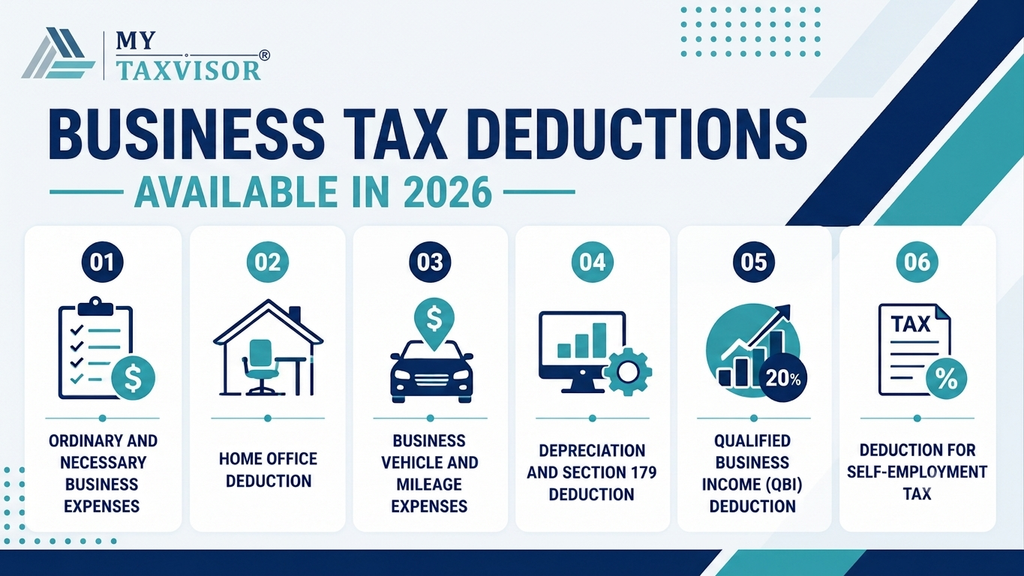
Self-employed individuals and eligible business owners may deduct qualifying expenses incurred in operating a trade or business. These deductions are separate from personal itemized deductions.
Ordinary and Necessary Business Expenses
Businesses can generally deduct expenses that are ordinary and necessary for their operations. An ordinary expense is common and accepted in the business, while a necessary expense is helpful and appropriate.
Potentially deductible expenses include:
- Business advertising and marketing.
- Office supplies and eligible software.
- Qualifying accounting and legal fees.
- Business insurance premiums.
- Eligible rent and utilities.
- Employee wages and qualifying benefits.
Personal expenses are generally not deductible. For expenses used for both business and personal purposes, only the eligible business portion may qualify.
Home Office Deduction
Self-employed individuals may deduct eligible home office expenses if the space meets the applicable business-use requirements. Generally, the space must be used regularly and exclusively for business, subject to exceptions for certain qualifying uses.
Eligible taxpayers may use the simplified method or the regular method. Employees generally cannot deduct unreimbursed employee business expenses through a federal home office deduction under current federal rules.
Business Vehicle and Mileage Expenses
Self-employed individuals may deduct eligible vehicle expenses attributable to business use. Depending on eligibility and prior elections, they may use the standard mileage rate or the actual expense method.
The actual expense method allocates eligible costs, such as fuel, repairs, insurance, and depreciation, according to business use. The standard mileage method uses the applicable IRS rate for qualifying business miles.
Maintain adequate mileage records and supporting documentation. Personal commuting is generally not deductible as business mileage.
Depreciation and Section 179 Deduction
Businesses may recover the cost of qualifying equipment, machinery, computers, furniture, and other depreciable property through depreciation deductions.
Section 179 allows eligible businesses to elect to deduct the cost of qualifying property in the year it is placed in service. For 2026, the maximum Section 179 deduction is $2,560,000, subject to a phaseout when qualifying property placed in service exceeds $4,090,000. A separate limit applies to qualifying sport utility vehicles.
Bonus depreciation may also be available for qualifying property. Section 179, bonus depreciation, and regular depreciation have different requirements and can affect when a business recovers an asset’s cost.
Qualified Business Income (QBI) Deduction
Eligible owners of pass-through businesses may qualify for the qualified business income deduction under Section 199A. The deduction can generally reach 20% of qualified business income, subject to applicable limitations.
Eligible businesses may include sole proprietorships, partnerships, S corporations, and certain trusts or estates. C corporations generally do not qualify.
The calculation may depend on taxable income, business type, W-2 wages, and qualified property. Specified service businesses face additional restrictions at higher income levels.
For 2026, the deduction is permanent under current law. Eligible taxpayers with at least $1,000 in qualified business income from an active trade or business in which they materially participate may also qualify for a minimum deduction of $400, subject to the applicable rules.
Deduction for Self-Employment Tax
Self-employed individuals generally pay both the employer and employee portions of Social Security and Medicare taxes through self-employment tax.
Eligible taxpayers may deduct the employer-equivalent portion when calculating AGI. This reduces income subject to federal income tax but does not eliminate the self-employment tax owed.
What New Federal Tax Deductions Apply in 2026?
Several deductions introduced or expanded under 2025 tax legislation apply in 2026. Eligible taxpayers may claim these deductions whether they itemize or take the standard deduction, subject to the relevant requirements and income limits.
Deduction for Qualified Tips
Eligible workers in occupations that customarily and regularly receive tips may deduct qualified tip income.
For 2026, the maximum deduction is $25,000. It begins to phase out when modified adjusted gross income exceeds $150,000, or $300,000 for married couples filing jointly.
Only qualifying tips are eligible. The deduction does not eliminate Social Security or Medicare tax obligations. Valid Social Security number and filing-status requirements also apply.
Deduction for Qualified Overtime Compensation
Eligible workers may deduct qualifying overtime compensation required under the Fair Labor Standards Act. The deduction generally applies to the premium portion above the employee’s regular rate of pay, not the entire overtime payment.
For 2026, the maximum deduction is $12,500, or $25,000 for married couples filing jointly. It begins to phase out when modified adjusted gross income exceeds $150,000, or $300,000 for joint filers.
Reporting, Social Security number, and filing-status requirements apply. Married taxpayers must generally file jointly to claim this deduction.
Deduction for Qualified Vehicle Loan Interest
Eligible taxpayers may deduct up to $10,000 in qualified interest paid on a loan for a qualifying passenger vehicle purchased for personal use. The vehicle must meet the applicable requirements, including final assembly in the United States, and the loan generally must have originated after December 31, 2024.
The deduction phases out for taxpayers with modified adjusted gross income above $100,000, or $200,000 for married couples filing jointly. Used vehicles and lease payments generally do not qualify under this provision.
The deduction is for qualifying loan interest, not the vehicle’s purchase price or principal repayments. Review the IRS guidance on new and enhanced deductions for current eligibility requirements.
Enhanced Deduction for Seniors
Eligible taxpayers age 65 or older may qualify for an additional deduction of up to $6,000 per eligible person. Married couples may qualify for up to $12,000 if both spouses meet the requirements.
The deduction phases out when modified adjusted gross income exceeds $75,000, or $150,000 for married couples filing jointly. Social Security number and filing-status requirements also apply.
This deduction is separate from the additional standard deduction for age or blindness. Eligible taxpayers may qualify for both, depending on their circumstances.
Review the IRS guidance on the enhanced senior deduction to verify eligibility and calculate any reduction.
How Do You Claim Federal Income Tax Deductions for 2026?
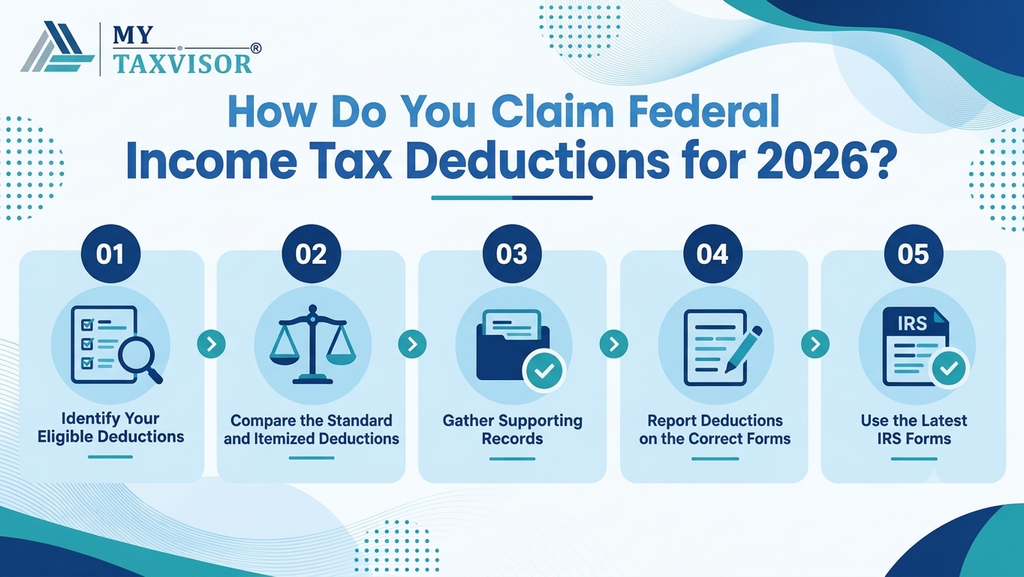
Claiming deductions requires identifying eligible expenses, checking the relevant limits, and reporting each deduction on the appropriate tax forms.
1. Identify Your Eligible Deductions
Review your income, filing status, expenses, retirement contributions, and business activities to identify deductions that may apply.
2. Compare the Standard and Itemized Deductions
Compare your allowable itemized deductions with the standard deduction. Also consider eligible adjustments to income and deductions available without itemizing, including those reported on Schedule 1-A.
3. Gather Supporting Records
Collect relevant tax forms, receipts, charitable contribution records, mortgage interest statements, student loan interest statements, retirement account records, business expense records, and vehicle mileage logs. Retain documentation for the period required by IRS rules.
4. Report Deductions on the Correct Forms
Different deductions require different forms or schedules. Itemized deductions are generally reported on Schedule A, while business income and expenses may be reported on Schedule C for eligible sole proprietors. Other deductions may require Schedule 1, Schedule 1-A, Form 7206, or other applicable forms.
Use the correct forms and instructions for tax year 2026 rather than relying on prior-year requirements. You can find current forms through the IRS Forms and Instructions directory.
If your return includes several income sources, business deductions, or new deductions, professional review can help ensure that the amounts are reported consistently and supported by the required records. MyTaxVisor provides tax preparation services for individuals and businesses that need assistance with federal tax filing.
Common Mistakes to Avoid When Claiming Tax Deductions
Incorrect claims can result in disallowed deductions, additional tax, or penalties. Avoid these common mistakes:
- Claiming personal expenses as business deductions: Only eligible business expenses or qualifying business-use portions may be deducted.
- Ignoring income limits and phaseouts: Some deductions decrease as income rises.
- Deducting reimbursed expenses or claiming expenses twice: The same expense generally cannot be deducted more than once.
- Failing to maintain supporting records: Keep documentation establishing the amount and eligibility of each deduction.
- Using outdated tax figures or forms: Limits and reporting requirements can change annually.
- Assuming new deductions apply automatically: The deductions for tips, overtime, vehicle loan interest, and seniors have specific eligibility requirements.
Get Professional Help With Your Federal Tax Deductions
Federal tax deductions involve different eligibility requirements, income limits, documentation standards, and reporting procedures. Applying the correct rules can help you avoid missed deductions and inaccurate claims.
MyTaxVisor helps individuals and businesses with tax preparation and related accounting requirements. Contact MyTaxVisor to discuss your tax preparation needs and determine which deductions may apply to your circumstances.
Explore our tax preparation services or learn more about MyTaxVisor to discuss your tax filing needs.
FAQs
1. Can I deduct expenses I paid for my parents’ medical care?
You may be able to deduct qualifying medical expenses paid for a parent if the applicable dependency rules are met. The deductible amount is generally limited to eligible unreimbursed expenses exceeding 7.5% of your AGI, and you must itemize.
2. Can I deduct interest on a home equity loan used to pay off credit card debt?
Generally, no. Interest on a home equity loan used for personal expenses, such as credit card debt, does not qualify as deductible home mortgage interest. The funds generally must be used to buy, build, or substantially improve the home securing the loan, subject to other requirements.
3. Can I deduct expenses from a side business if I also earn a salary?
Yes, if you operate a qualifying business and the expenses meet the ordinary and necessary business expense rules. You must report the business income and expenses correctly, and personal expenses cannot be deducted as business costs.
4. Can I amend my tax return if I missed an eligible deduction?
You may be able to correct an eligible missed deduction by filing an amended federal tax return, generally using Form 1040-X. The deadline and the effect on your tax liability depend on the circumstances and applicable rules.
5. Can I deduct a business expense paid with my personal credit card?
Yes, if the expense qualifies as an ordinary and necessary business expense and you can substantiate its business purpose and amount. Paying with a personal card does not automatically disqualify the expense, but you must separate business costs from personal spending.