Federal income tax credits can lower your tax bill, and in certain instances, even raise the amount of your refund. But the credits that you may be able to claim will vary according to your income, filing status, dependents, education costs, retirement savings, and other financial considerations.
The knowledge of Federal Income Tax Credits 2026 will enable you to know about the credits that you might be entitled to before you file your next tax return. Some of these credits are refundable, whereas some just lower your tax liability. Every credit has its own eligibility criteria and limitations.
This document discusses the main federal tax credits for individuals and families, their value, and the tax forms for claiming them.
Key Takeaways
- Federal income tax credits reduce your tax liability dollar for dollar. Refundable credits may also increase your refund.
- The Child Tax Credit is worth up to $2,200 per qualifying child in tax year 2026.
- Eligible workers, parents, students, caregivers, and retirees may qualify for different federal tax credits.
- The Child and Dependent Care Credit can cover up to 50% of eligible expenses in 2026, depending on income.
- Several clean-energy tax credits ended for new qualifying purchases or expenses after deadlines in 2025.
- Tax year 2026 covers income earned from January 1 through December 31, 2026. Most taxpayers will file their returns in 2027.
What Are Federal Income Tax Credits?
Federal tax credits reduce your federal income tax directly. They are different from tax deductions, where deductions are applied to the income used in the computation of your tax. In case your federal tax is $5,000 and you get a $1,000 non-refundable tax credit, then your tax liability will be reduced to $4,000. A refundable credit may also result in a refund in case your tax credit is greater than your tax liability.
Some of the IRS tax credits include child-related credits, education credits, childcare credits, retirement savings credits, adoption credits, and more.
Refundable vs. Nonrefundable Tax Credits
The difference between refundable and nonrefundable credits determines how much of a credit you can use.
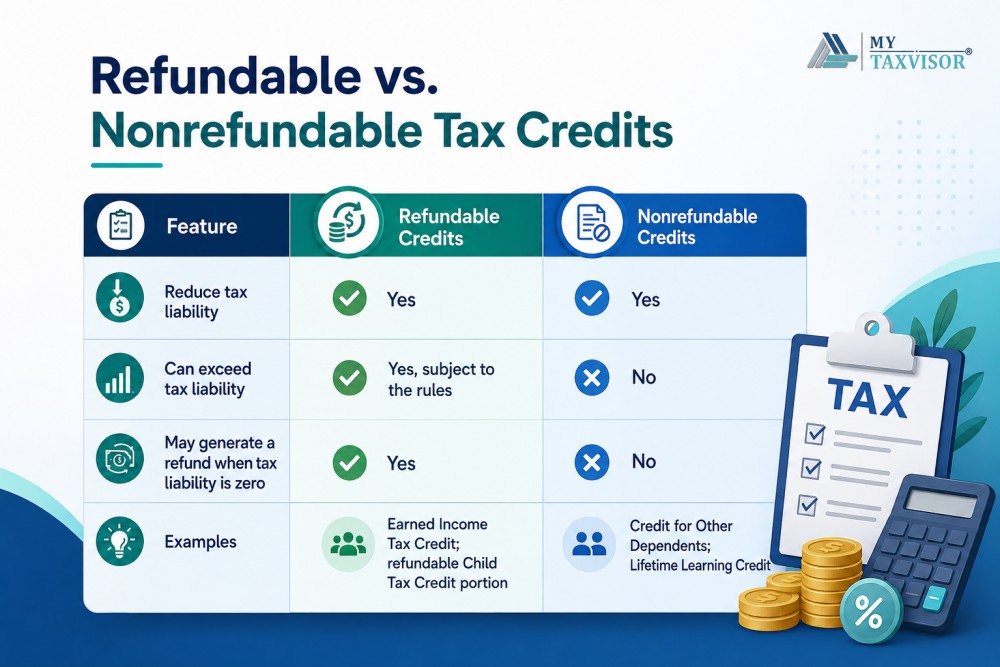
Some credits combine refundable and nonrefundable portions. For example, eligible taxpayers may claim the Additional Child Tax Credit when they cannot use the full Child Tax Credit against their tax liability.
Major Federal Income Tax Credits for 2026
1. Child Tax Credit (CTC)
Child Tax Credit can help eligible parents and guardians save money on their federal income taxes.
In tax year 2026, the maximum credit amount is $2,200 per qualifying child. The eligible taxpayer can claim up to $1,700 per qualifying child as the Additional Child Tax Credit, which is refundable, according to the eligibility criteria.
The qualifying child should be under the age of 17 at the end of 2026, should satisfy the relationship and residency requirements, should be a dependent of the taxpayer, and should have a valid Social Security number. The taxpayer should also satisfy the identification criteria.
The entire credit is usually allowed if the modified adjusted gross income is less than $200,000 for most individual taxpayers or $400,000 for joint taxpayers.
How to claim it: Report your qualifying child on Form 1040 and complete Schedule 8812 when required. Check the IRS Child Tax Credit guidance for eligibility details.
2. Earned Income Tax Credit (EITC)
Earned Income Tax Credit is meant for those who are eligible and have low to moderate earned income. This means that those who qualify for the credit can be issued a refund even if they do not owe any taxes.
The amount of your credit is based on earned income, adjusted gross income, your filing status, and number of qualifying children. Those without qualifying children but who meet other qualifications may also qualify. You need to have qualifying earned income and a Social Security Number.
How to claim it: Use the IRS EITC Assistant to check your eligibility. You may need Schedule EIC with Form 1040 if you claim qualifying children. Review the IRS Earned Income Tax Credit page for the applicable 2026 limits.
3. Credit for Other Dependents
Credit for Other Dependents is available at the rate of $500 for each eligible dependent that cannot be claimed as a dependent under the Child Tax Credit.
Eligible dependents can include children of higher age and qualifying relatives. The dependent has to satisfy all the applicable relationship, residency, support, and identification conditions. This credit is non-refundable and starts phasing out above the income level of $200,000 (or $400,000 for joint filers).
How to claim it: Report the dependent on your return and complete Schedule 8812 when required. You cannot claim both the Child Tax Credit and the Credit for Other Dependents for the same dependent.
4. Child and Dependent Care Credit
The credit allows taxpayers to pay for expenses that make it possible for them and their spouse, if filing jointly, to work or search for employment.
In 2026, the credit will cover between 20% and 50% of eligible expenses based on income levels. Qualifying expenses will be limited to $3,000 for one eligible individual or $6,000 for two or more individuals, resulting in maximum credit amounts of $1,500 and $3,000, respectively.
Eligible care includes day care, babysitting, and some before- or after-school care. The care recipient must usually be a child under the age of 13 or an eligible spouse or dependent incapable of caring for themselves.
You generally need earned income, and special rules apply to employer-provided dependent care benefits. You cannot use the same expenses twice where the rules prohibit it.
How to claim it: Complete Form 2441 and retain care provider details and expense records. See the IRS Child and Dependent Care Credit guidance.
5. American Opportunity Tax Credit (AOTC)
American Opportunity Tax Credit can assist eligible students in meeting their college costs during the first four years of post-secondary education.
The credit is worth up to $2,500 for each eligible student per year, according to the first $4,000 of qualified expenses. 40% of the credit can be refundable for some eligible individuals.
Qualified expenses usually include tuition, enrollment fees, and some books. Room and board or transportation are not qualified expenses.
The eligible student must seek a recognized educational credential, be enrolled at least half-time in an eligible educational institution for an eligible educational period, and meet the other IRS criteria. The income phase-outs for the tax credit start at $80,000 to $90,000 for individual filers and $160,000 to $180,000 for joint filers.
For 2026, new Social Security number requirements apply to taxpayers claiming education credits and, in relevant cases, the students for whom expenses were paid.
How to claim it: Complete Form 8863. Check the IRS education credits guidance for current eligibility and documentation rules.
6. Lifetime Learning Credit (LLC)
The Lifetime Learning Credit is for eligible taxpayers who need help paying for qualified education after their first four years of college.
The lifetime learning credit is worth up to $2,000 for every eligible taxpayer per year, or 20% of up to $10,000 in qualified expenses.
The lifetime learning credit is not refundable, unlike the American Opportunity Tax Credit. There are income limitations, and taxpayers cannot claim two education credits for one student in the same year.
How to claim it: Complete Form 8863. Review the IRS education credits guidance to determine which credit better fits your circumstances.
7. Adoption Tax Credit
The Adoption Tax Credit helps eligible taxpayers cover qualified adoption expenses, including certain adoption fees, court costs, attorney fees, and related travel.
For tax year 2026, the maximum credit is $17,670 per qualifying child, with up to $5,120 refundable. The nonrefundable portion may generally be carried forward for up to five years.
The child generally must be under age 18 or physically or mentally incapable of self-care. Income limits apply: the full credit is generally available at modified adjusted gross income of $265,080 or less, phases out between $265,081 and $305,079, and is unavailable at $305,080 or more.
Special rules apply to domestic and foreign adoptions and qualifying special-needs adoptions.
How to claim it: Complete Form 8839 and Schedule 3-A when claiming the refundable portion. Consult the IRS Adoption Credit guidance.
8. Retirement Savings Contributions Credit (Saver’s Credit)
The Saver’s Credit rewards eligible taxpayers with modest incomes for contributing to qualifying retirement accounts, such as traditional or Roth IRAs and certain workplace retirement plans.
The credit is generally 10%, 20%, or 50% of eligible contributions, depending on income and filing status. Eligible contributions are capped at $2,000 per person, or $4,000 for married couples filing jointly. The maximum credit is therefore $1,000 for an individual or $2,000 for a joint return.
You generally must be at least 18, cannot be claimed as another person’s dependent, and cannot be a full-time student under the IRS definition. Income limits apply, and the credit is nonrefundable.
How to claim it: Complete Form 8880 and check the applicable 2026 income thresholds in the IRS instructions.
9. Premium Tax Credit (PTC)
The Premium Tax Credit helps eligible individuals and families pay for health insurance purchased through the Health Insurance Marketplace.
The amount depends on household income, family size, qualifying coverage, and other eligibility rules. Advance payments may go directly to your insurer to reduce monthly premiums.
For 2026, the general income eligibility range is again 100% to 400% of the federal poverty line, subject to applicable exceptions. The temporary expanded eligibility that applied through 2025 has ended.
If you received advance payments, you must reconcile them with the credit allowed based on your actual annual household income.
How to claim it: Complete Form 8962 using the information from Form 1095-A. See the IRS Premium Tax Credit guidance.
10. Foreign Tax Credit
The Foreign Tax Credit helps eligible taxpayers avoid double taxation on certain income earned outside the United States.
If you paid qualifying foreign income taxes to another country or U.S. possession, you may be able to claim a credit against your U.S. federal income tax. This can be relevant to U.S. citizens, resident aliens, and taxpayers with foreign employment or investment income.
The credit does not cover every foreign tax or eliminate all double taxation. The allowable amount depends on the type of income, qualifying taxes paid, and applicable limitations.
How to claim it: Eligible taxpayers may claim the credit directly on their return in certain cases or use Form 1116. Check the IRS instructions for the applicable rules.
11. Credit for the Elderly or the Disabled
Certain taxpayers aged 65 or older and some younger taxpayers who are permanently and totally disabled may qualify for this credit if they meet the income and other requirements.
Eligibility depends on filing status, income, nontaxable Social Security benefits, and qualifying disability income. The credit is nonrefundable, and not every senior or taxpayer with a disability qualifies.
How to claim it: Review Schedule R and the IRS instructions before claiming the credit.
12. Mortgage Credit Certificate Credit
Homeowners who qualify under an eligible Mortgage Credit Certificate (MCC) issued by a participating state or local government agency can qualify for a federal credit depending on a percentage of the eligible mortgage interest paid.
Not all homeowners qualify for this credit; rather, the certificate determines what percentage applies.
How to claim it: Complete Form 8396 if you meet the requirements.
Federal Tax Credits That Ended or Changed for 2026
Taxpayers should check the dates attached to clean-energy incentives because legislation enacted in 2025 changed several credits.
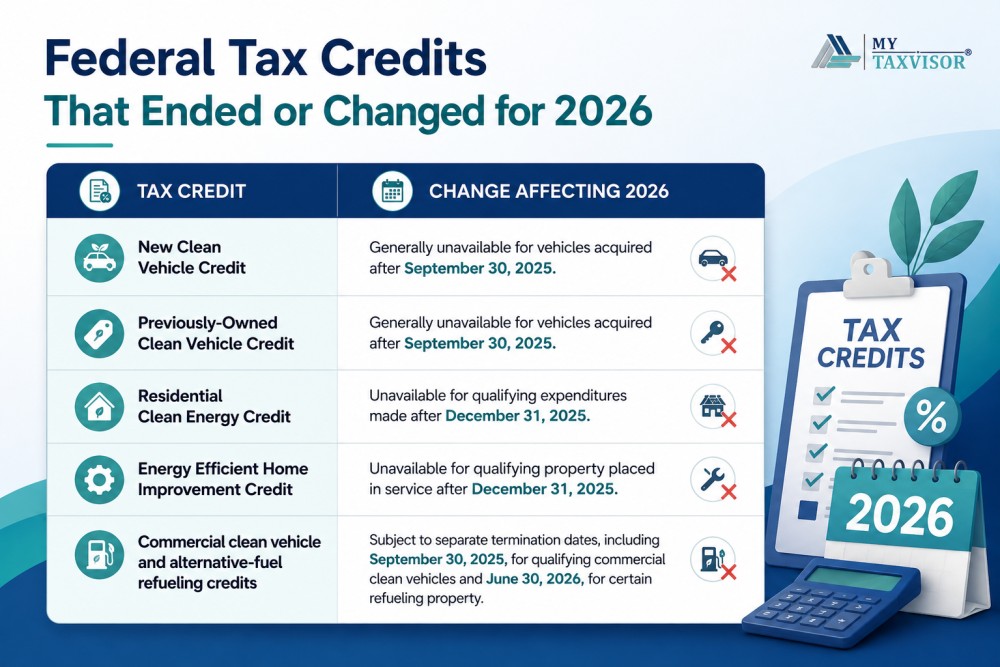
These deadlines do not necessarily prevent taxpayers from claiming an eligible credit for a transaction completed before the applicable cutoff. The acquisition, expenditure, or placed-in-service date matters, depending on the credit.
For details, review the IRS Working Families Tax Cuts guidance and the relevant credit-specific instructions.
How to Claim Federal Income Tax Credits in 2026
Follow these steps to identify eligible credits and prepare your return accurately.
- Review your circumstances. Consider your income, filing status, dependents, education expenses, childcare costs, retirement contributions, and health insurance coverage.
- Gather supporting documents. Collect Forms W-2 and 1099, dependent information, education records, childcare receipts, adoption documents, retirement statements, and Form 1095-A where applicable.
- Check eligibility and income limits. Use the requirements for tax year 2026 rather than relying on figures from an older return.
- Complete the correct forms. Most credits are reported through Form 1040, with additional forms or schedules where required, such as Forms 2441, 8839, 8863, and 8962.
- Review your return. Check your calculations and supporting records, and make sure you have not claimed the same expenses more than once where prohibited.
The IRS provides official eligibility tools and instructions for many credits. If your return involves several credits, foreign income, adoption expenses, or Marketplace insurance, professional tax preparation may help you determine which rules apply.
How Federal Income Tax Credits Affect Your Tax Bracket
These are two distinct tools. Your tax bracket decides what rates are used to tax various components of your taxable income. The credits act to lower the overall tax that is calculated.
For instance, if your income tax calculated based on the Federal income tax system is $6,000 and you have a $1,500 non-refundable tax credit, your tax liability could be reduced to $4,500.
This does not mean that you will subtract $1,500 from your taxable income and thus reduce your tax bracket.
Read our guide to Federal Income Tax Brackets 2026 to understand the tax rates, income thresholds, and filing statuses used to calculate your initial federal tax liability.
Get Help Reviewing Your 2026 Federal Tax Credits
Missing an eligible credit can mean paying more federal income tax than necessary. Claiming a credit incorrectly can lead to refund adjustments, additional tax, or requests for supporting documents.
MyTaxVisor can help you review your tax preparation needs and understand the requirements relevant to your circumstances. Explore the available tax services before submitting your 2026 federal income tax return.
Review your eligible tax credits, organize your documents, and prepare your 2026 federal tax return with confidence.
Frequently Asked Questions About Federal Income Tax Credits 2026
1. Can I claim a federal tax credit if no federal income tax was withheld from my paycheck?
Possibly. Withholding is different from your final tax liability. Eligible taxpayers may claim refundable credits even when no federal income tax was withheld, provided they meet the relevant requirements and file a return when necessary.
2. Can I claim education credits if I paid student loan interest instead of tuition?
Not for the same reason. Education credits generally apply to qualifying education expenses paid during the tax year, while student loan interest may qualify for a separate deduction. Check the IRS rules for each benefit before claiming it.
3. Can I claim a tax credit for expenses reimbursed by my employer?
Generally, you cannot claim the same expense twice when the rules prohibit it. Employer reimbursements or tax-free benefits may reduce the expenses eligible for a credit. Review the specific credit’s instructions before calculating your claim.
4. What should I do if I discover that I missed a tax credit on a previously filed return?
You may be able to correct the return by filing an amended federal income tax return, generally using Form 1040-X. The deadline and eligibility depend on the circumstances, so check the IRS guidance before amending.
Disclaimer: This article provides general information for tax year 2026 and is not a substitute for individualized tax advice. Credit amounts, eligibility requirements, and tax laws may change. Confirm the applicable rules and forms using current IRS guidance before filing.