

Key Takeaways: Federal Income Tax Brackets 2026
- The seven federal income tax rates for 2026 are 10%, 12%, 22%, 24%, 32%, 35%, and 37%.
- The highest 37% rate applies to taxable income above $640,600 for single filers and $768,700 for married couples filing jointly.
- The standard deduction for 2026 is $16,100 for single filers, $32,200 for married couples filing jointly, and $24,150 for heads of household.
- Your federal income tax bracket depends on your taxable income and filing status, not simply your annual salary.
- Deductions generally reduce taxable income, while tax credits reduce your calculated tax liability.
- Personal exemption deductions are not available under current federal tax rules, although eligible taxpayers can claim certain dependent-related credits.
- The 2026 tax brackets apply to income earned during 2026 and generally reported on a tax return filed in 2027.
What Are Federal Income Tax Brackets?
Federal income tax brackets are income ranges that determine the tax rate applied to different portions of your taxable income. The United States uses a progressive income tax system, which means higher portions of taxable income may be taxed at higher rates.
For 2026, the federal income tax system has seven ordinary tax rates, ranging from 10% to 37%. The income thresholds for these rates depend on whether you file as single, married filing jointly, married filing separately, or head of household.
For example, a single taxpayer with $80,000 in taxable income falls into the 22% marginal tax bracket. However, the taxpayer does not pay 22% on the entire $80,000. Different portions of the income are taxed at 10%, 12%, and 22%.
Understanding this distinction helps you estimate your tax liability without assuming that moving into a higher bracket increases the tax rate on all your income.
What Are Federal Income Tax Rates?
A tax rate is the percentage used to calculate tax on a particular portion of taxable income. The seven ordinary federal income tax rates for 2026 are 10%, 12%, 22%, 24%, 32%, 35%, and 37%. Two related terms are important when calculating your tax liability:
- Marginal tax rate: The rate that generally applies to your next dollar of ordinary taxable income. It corresponds to the highest bracket you reach.
- Effective tax rate: Your total regular federal income tax divided by taxable income. If you use gross income instead, you are calculating the effective rate on gross income.
Your effective rate is often lower than your marginal rate because your income is taxed across multiple brackets.
Understanding Gross Income, AGI, and Taxable Income
Before looking at the 2026 tax brackets, you need to understand how the IRS determines the amount of income subject to tax. Gross income, adjusted gross income, and taxable income represent different stages of that calculation.
What Is Gross Income?
Gross income generally includes income from taxable sources before applicable adjustments and deductions. Depending on your circumstances, it may include:
- Wages, salaries, bonuses, and commissions
- Business and self-employment income
- Taxable interest and dividends
- Rental income and capital gains
- Taxable retirement distributions
- Other taxable income
Some income is excluded or treated differently under federal tax rules. Therefore, not every payment you receive is necessarily taxable.
For example, if you earn $70,000 in wages and receive $1,000 in taxable interest, your gross income would generally be $71,000 before applicable adjustments and deductions.
Source: IRS Publication 525: Taxable and Nontaxable Income.
What Is Adjusted Gross Income (AGI)?
Adjusted gross income, or AGI, is your gross income after subtracting eligible adjustments to income. Depending on your circumstances, these adjustments may include qualifying deductions for certain retirement contributions, health savings account contributions, student loan interest, and other permitted expenses.
AGI is important because it can affect your eligibility for tax deductions, credits, and other benefits. Some tax provisions use modified adjusted gross income (MAGI), which adds back certain amounts under specific rules.
Example:
| Calculation | Amount |
|---|---|
| Wages | $70,000 |
| Taxable interest | $1,000 |
| Gross income | $71,000 |
| Eligible adjustments | $2,000 |
| Adjusted gross income | $69,000 |
The $2,000 adjustment is illustrative. The amount you can claim depends on the relevant deduction and your eligibility.
What Is Taxable Income?
Taxable income is the amount generally used to determine your federal income tax bracket. It is calculated after accounting for applicable adjustments and deductions.
The calculation broadly follows this structure:
Gross income − eligible adjustments = Adjusted gross income
Adjusted gross income − applicable deductions = Taxable income
Other deductions and special provisions may affect the final calculation.
For example, a single taxpayer with $80,000 in gross income, $2,000 in eligible adjustments, and a $16,100 standard deduction would have $61,900 in taxable income, assuming no other income or deductions.
That taxable income falls within the 22% marginal federal income tax bracket for 2026.
Federal Income Tax Deductions and Exemptions
Deductions and exemptions can affect how much income is subject to federal income tax. However, personal exemption deductions are no longer available under current federal tax rules.
What Is a Tax Deduction?
A tax deduction reduces the income used to calculate federal income tax. Eligible taxpayers may claim the standard deduction, itemized deductions, and other deductions permitted under federal law.
Standard Deduction for 2026
The standard deduction is a fixed amount that eligible taxpayers can subtract when calculating taxable income.
| Filing Status | 2026 Standard Deduction |
|---|---|
| Single | $16,100 |
| Married filing jointly | $32,200 |
| Married filing separately | $16,100 |
| Head of household | $24,150 |
| Qualifying surviving spouse | $32,200 |
Source: IRS 2026 tax adjustments.
Itemized Deductions
Itemized deductions allow eligible taxpayers to deduct qualifying expenses instead of claiming the standard deduction. Depending on your circumstances, these may include:
- Eligible state and local taxes
- Qualifying mortgage interest
- Charitable contributions
- Certain medical and dental expenses
- Other expenses allowed under federal tax rules
Limits and eligibility requirements apply. Compare your eligible itemized deductions with the standard deduction available to you before choosing which method to use.
Additional Deductions for 2026
Federal legislation enacted in 2025 introduced or expanded several deductions for eligible taxpayers. These include deductions for qualifying tips, certain overtime compensation, qualifying passenger vehicle loan interest, and an enhanced deduction for eligible seniors.
Each provision has its own limits, income phaseouts, and eligibility requirements. These deductions may reduce taxable income, but they do not automatically exempt the underlying income from every federal tax.
For details, review the IRS overview of tax changes for individuals and workers.
What Are Personal Exemptions?
Personal exemptions historically allowed taxpayers to subtract a specified amount for themselves, their spouses, and qualifying dependents. However, personal exemption deductions are not available under current federal income tax rules.
You cannot subtract a personal exemption amount for yourself, your spouse, or your dependents when calculating your 2026 taxable income.
This does not mean dependents have no tax significance. Eligible taxpayers may still qualify for the Child Tax Credit, the Credit for Other Dependents, or other tax benefits.
What Is the Difference Between a Deduction and a Tax Credit?
A deduction generally reduces taxable income before tax is calculated. A tax credit generally reduces the calculated tax liability, subject to the credit’s eligibility rules and limitations.
For example, a $1,000 deduction does not usually reduce your tax bill by $1,000. The tax savings depend on your applicable tax rate. A $1,000 tax credit, if fully available and applicable, can reduce your calculated tax by $1,000.
2026 Federal Income Tax Brackets by Filing Status
The IRS uses different income thresholds for different filing statuses. Choose the table that matches your filing status to determine which tax rates apply to your taxable income.
Federal Income Tax Brackets for Single Filers
Single filing status generally applies to individuals who are unmarried and do not qualify for another filing status.
| Tax Rate | Taxable Income |
|---|---|
| 10% | $0 to $12,400 |
| 12% | Over $12,400 to $50,400 |
| 22% | Over $50,400 to $105,700 |
| 24% | Over $105,700 to $201,775 |
| 32% | Over $201,775 to $256,225 |
| 35% | Over $256,225 to $640,600 |
| 37% | Over $640,600 |
Federal Income Tax Brackets for Married Filing Jointly
Married couples who file a joint federal income tax return generally combine their relevant income and deductions on one return.
| Tax Rate | Taxable Income |
|---|---|
| 10% | $0 to $24,800 |
| 12% | Over $24,800 to $100,800 |
| 22% | Over $100,800 to $211,400 |
| 24% | Over $211,400 to $403,550 |
| 32% | Over $403,550 to $512,450 |
| 35% | Over $512,450 to $768,700 |
| 37% | Over $768,700 |
Federal Income Tax Brackets for Married Filing Separately
Married taxpayers who file separate returns generally use the following brackets.
| Tax Rate | Taxable Income |
|---|---|
| 10% | $0 to $12,400 |
| 12% | Over $12,400 to $50,400 |
| 22% | Over $50,400 to $105,700 |
| 24% | Over $105,700 to $201,775 |
| 32% | Over $201,775 to $256,225 |
| 35% | Over $256,225 to $384,350 |
| 37% | Over $384,350 |
Filing separately may affect eligibility for certain deductions and credits. Couples should compare the overall tax consequences of each eligible filing method before deciding.
Federal Income Tax Brackets for Head of Household
Head of household status is generally available to eligible unmarried taxpayers who meet IRS requirements relating to household costs and qualifying dependents.
| Tax Rate | Taxable Income |
|---|---|
| 10% | $0 to $17,700 |
| 12% | Over $17,700 to $67,450 |
| 22% | Over $67,450 to $105,700 |
| 24% | Over $105,700 to $201,750 |
| 32% | Over $201,750 to $256,200 |
| 35% | Over $256,200 to $640,600 |
| 37% | Over $640,600 |
Head of household filers generally have wider income thresholds in the lower brackets than single filers. However, being unmarried or supporting a family member does not automatically qualify you for this status.
Review the IRS filing-status guidance to confirm your eligibility.
Federal Income Tax Brackets for Estates and Trusts
Estates and trusts use a separate federal income tax schedule.
| Tax Rate | Taxable Income |
|---|---|
| 10% | $0 to $3,300 |
| 24% | Over $3,300 to $11,700 |
| 35% | Over $11,700 to $16,000 |
| 37% | Over $16,000 |
The applicable tax treatment depends on the type of entity, its income, and whether income is retained or distributed to beneficiaries.
Official source for the 2026 tax brackets: IRS Revenue Procedure 2025-32.
How to Calculate Federal Income Tax for 2026
Once you know your taxable income and filing status, you can estimate your regular federal income tax by applying the relevant rates to each portion of income.
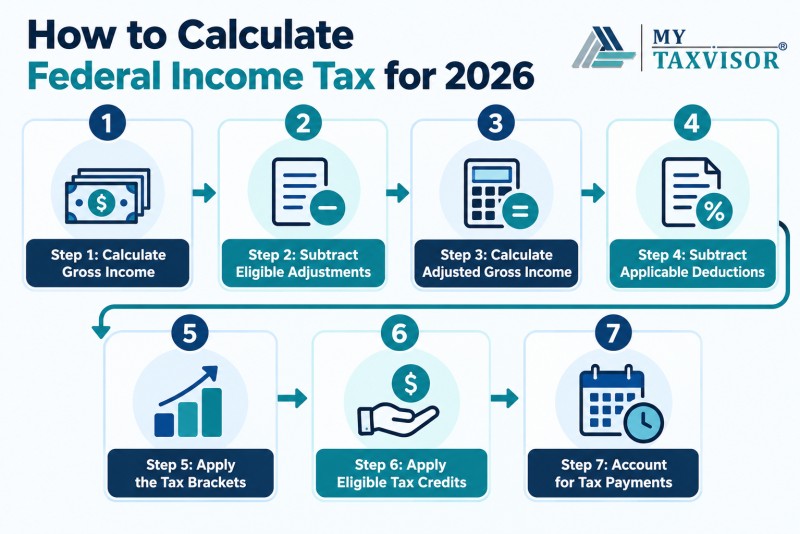
Step 1: Calculate Gross Income
Add your taxable wages, business income, interest, dividends, and other income that must be included under federal tax rules.
Step 2: Subtract Eligible Adjustments
Determine whether you qualify for adjustments to income, such as eligible retirement contributions or other permitted deductions.
Step 3: Calculate Adjusted Gross Income
Subtract eligible adjustments from gross income to determine your AGI.
Step 4: Subtract Applicable Deductions
Apply the standard deduction, itemized deductions, and any other deductions you qualify to claim. The result is generally your taxable income.
Step 5: Apply the Tax Brackets
Use the table for your filing status. Calculate the tax on each portion of taxable income and add the amounts together.
Step 6: Apply Eligible Tax Credits
Subtract applicable tax credits from your calculated tax, subject to their eligibility and limitations.
Step 7: Account for Tax Payments
Compare your remaining tax liability with federal income tax withholding and estimated tax payments. This helps determine whether you owe additional tax or may receive a refund. Other federal taxes may apply separately.
Example: Federal Income Tax on $80,000
Suppose you are a single taxpayer with $80,000 in wages, no other income or adjustments, and claim the $16,100 standard deduction.
| Calculation | Amount |
|---|---|
| Gross income | $80,000 |
| Standard deduction | $16,100 |
| Taxable income | $63,900 |
Your regular federal income tax is calculated as follows:
| Taxable Income Portion | Tax Rate | Tax Amount |
|---|---|---|
| First $12,400 | 10% | $1,240 |
| Next $38,000 | 12% | $4,560 |
| Remaining $13,500 | 22% | $2,970 |
| Total regular federal income tax | $8,770 |
Your marginal tax rate is 22%, while your effective tax rate on taxable income is approximately 13.73%.
This is an illustrative calculation before tax credits, additional taxes, or other adjustments. It assumes the standard deduction is the only deduction and that no other special provisions apply.
Tax Credits That Can Reduce Your Federal Income Tax
Tax credits reduce the amount of federal income tax you owe. Some are nonrefundable, meaning they can reduce your tax to zero but generally cannot create a refund on their own. Others are refundable, allowing eligible taxpayers to receive a refund even when the credit exceeds their tax liability.
The credits available to you depend on your income, filing status, family circumstances, and other eligibility requirements.
Child Tax Credit and Credit for Other Dependents
Eligible taxpayers may claim the Child Tax Credit for qualifying children who meet the IRS requirements. For 2026, the maximum Child Tax Credit is $2,200 per qualifying child, subject to eligibility rules and income limitations.
The Credit for Other Dependents may be available for qualifying dependents who do not meet the requirements for the Child Tax Credit. The maximum credit is generally $500 per eligible dependent, subject to applicable rules.
The Child Tax Credit is generally nonrefundable, while eligible taxpayers may qualify for the refundable Additional Child Tax Credit.
Source: IRS Child Tax Credit guidance.
Earned Income Tax Credit (EITC)
The Earned Income Tax Credit helps eligible workers and families with low to moderate incomes. The credit amount depends on earned income, adjusted gross income, filing status, and the number of qualifying children.
The EITC is refundable, so eligible taxpayers may receive a refund even if they owe no federal income tax. Income limits and other requirements apply.
Source: IRS Earned Income Tax Credit guidance.
Child and Dependent Care Credit
Eligible taxpayers who pay for qualifying care so they can work or look for work may claim the Child and Dependent Care Credit.
For 2026, the credit can cover 20% to 50% of qualifying expenses, depending on adjusted gross income. The qualifying expense limits are $3,000 for one qualifying person and $6,000 for two or more. This means the maximum credit can reach $1,500 for one qualifying person or $3,000 for two or more, subject to the applicable rules.
The credit is nonrefundable. Qualifying care expenses and other eligibility requirements must be met.
Source: IRS Child and Dependent Care Credit guidance.
Education Credits
Eligible students and taxpayers paying qualifying education expenses may be able to claim one of two federal education credits:
- American Opportunity Tax Credit (AOTC): Helps cover qualifying expenses during the first four years of higher education. It can be worth up to $2,500 per eligible student, subject to the applicable rules.
- Lifetime Learning Credit (LLC): Helps cover qualifying tuition and related expenses for eligible higher education. It can be worth up to $2,000 per tax return, subject to eligibility requirements.
Income limits, qualifying expenses, student eligibility, and other restrictions apply. The credits cannot both be claimed for the same student in the same tax year.
Source: IRS education credits.
Adoption Tax Credit
Eligible taxpayers who adopt a qualifying child may claim the federal Adoption Tax Credit for qualifying adoption expenses. For 2026, the maximum credit is $17,670, and up to $5,120 may be refundable, subject to the applicable requirements and income limits.
Source: IRS Revenue Procedure 2025-32.
Foreign Tax Credit
Taxpayers who pay qualifying income taxes to a foreign country or US possession may be eligible for the Foreign Tax Credit. The credit can help reduce double taxation on certain income.
Eligibility and calculation requirements apply, and some taxpayers must file Form 1116.
Source: IRS Foreign Tax Credit guidance.
How Do Tax Credits Affect Your Final Tax Bill?
Tax credits are generally applied after your regular income tax has been calculated. The following simplified example shows how a nonrefundable credit can affect your tax liability.
| Calculation | Amount |
|---|---|
| Regular federal income tax | $5,000 |
| Eligible nonrefundable tax credit | $1,000 |
| Tax remaining before other adjustments and payments | $4,000 |
The actual result depends on the credit’s rules and your eligibility. Refundable credits may produce a refund even when the taxpayer’s regular income tax liability is zero.
The IRS adjusts many income thresholds for inflation. Federal tax legislation enacted in July 2025 also changed several deductions and other tax provisions. Taxpayers should therefore review both the updated bracket thresholds and the rules that affect taxable income.
Sources: IRS 2025 tax adjustments and IRS 2026 tax adjustments.
Other Federal Tax Rules to Consider
The seven ordinary federal income tax brackets do not cover every federal tax situation. Some types of income and taxpayers are subject to separate rules.
Capital Gains Tax
Short-term capital gains are generally taxed at ordinary income tax rates. Qualifying long-term capital gains may receive separate rates of 0%, 15%, or 20%, depending on taxable income and filing status. Some taxpayers may also owe additional tax on investment income.
Self-Employment Tax
Self-employed individuals may owe regular federal income tax as well as self-employment tax, which generally covers Social Security and Medicare taxes under the applicable rules.
Alternative Minimum Tax (AMT)
The Alternative Minimum Tax is a separate calculation that can affect certain taxpayers. Eligible taxpayers may need to calculate both regular tax and AMT and pay the applicable amount under the rules.
For 2026, the IRS has published an AMT exemption of $90,100 for single filers and $140,200 for married couples filing jointly, subject to applicable phaseout rules.
Source: IRS 2026 tax adjustments.
How to Plan for Your 2026 Federal Income Tax
A few practical steps can help you manage your tax obligations during the year.
- Review paycheck withholding: Changes in salary, bonuses, or household circumstances may mean you need to update your Form W-4.
- Plan for additional income: Bonuses, freelance payments, business income, and investment gains may increase taxable income.
- Check deductions and credits: Review retirement-related deductions, itemized deductions, and credits for which you may qualify.
- Keep accurate records: Maintain records of income, deductible expenses, charitable contributions, and estimated tax payments.
- Make estimated payments when required: Self-employed individuals and some other taxpayers may need to pay estimated taxes during the year.
Use the IRS Tax Withholding Estimator to review your withholding and the IRS estimated tax guidance to understand payment requirements.
Get Help With Your Federal Tax Planning
Understanding your tax bracket is only one part of calculating your federal income tax. Your income sources, filing status, deductions, tax credits, and other applicable rules all affect your final tax liability.
MyTaxVisor provides tax preparation, tax planning, accounting, and advisory services for individuals and businesses. Reviewing your tax situation with a qualified professional can help you understand the rules that apply to your income and prepare for your tax obligations.
Visit MyTaxVisor to explore its tax services and find support for your tax-related needs.
Frequently Asked Questions About Federal Income Tax Brackets 2026
1. If my salary increases, will I automatically pay more tax on all my income?
No. Federal income tax is progressive, so only the portion of ordinary taxable income that falls within a higher bracket is taxed at that rate. A salary increase may increase your overall tax, but it does not automatically subject all your income to the highest rate you reach.
2. Can I qualify for a tax refund if I owe no federal income tax?
Yes. Eligible taxpayers may receive a refund through refundable tax credits, such as the Earned Income Tax Credit or the refundable portion of the Child Tax Credit. You may also receive a refund if your federal withholding and other payments exceed your final tax liability.
3. Should I file jointly or separately if I am married?
The better option depends on your combined income, deductions, credits, and other circumstances. Filing jointly often provides wider income thresholds, but separate filing may be appropriate in certain situations. Compare the total tax outcome under each eligible filing status before deciding.
4. Do deductions and credits affect my tax bracket in the same way?
No. Deductions generally reduce taxable income and may affect which marginal tax bracket applies. Tax credits generally reduce the calculated tax liability rather than changing the tax bracket itself.
5. Do I need to pay estimated taxes if I earn freelance income?
You may need to make estimated tax payments if you expect to owe enough federal tax after withholding and refundable credits. The requirement depends on your expected tax liability and other applicable rules. Review the IRS estimated tax guidance to determine whether payments are required.
6. Are the federal income tax brackets the same as state income tax brackets?
No. Federal income tax brackets apply to federal income tax. State income tax rates, thresholds, deductions, and filing rules vary by state, and some states do not impose an individual income tax.
Disclaimer: This article provides general information about US federal income tax rules for the 2026 tax year. It is not individualized tax, legal, or financial advice. Tax laws, eligibility requirements, and personal circumstances can affect your final tax liability. Verify applicable requirements with the IRS or a qualified tax professional before making tax decisions.




Pingback: Federal Income Tax Credits 2026: Types, Eligibility, Amounts, and How to Claim Them – My Taxvisor