

Tax credit for installing solar power has been an essential financial tool for U.S. homeowners who want to transition to renewable sources. Lowering federal income tax liability encouraged people to invest more in solar panels and residential clean energy systems. However, the policy was subject to modification in 2026, which means that one needs to familiarize oneself with the change.
According to the 2025 Federal Tax Law, the Residential Clean Energy Credit that allowed eligible homeowners to claim 30% of qualifying expenses is not applicable for any new qualifying expenses made after December 31, 2025. This does not imply that all claims on solar tax credits became null and void. If you have performed an eligible installation during 2025, you are still eligible to make the claim on your 2025 federal tax return filed in 2026.
Key Takeaways
- The federal Residential Clean Energy Credit under Section 25D ended for new qualifying expenditures after December 31, 2025.
- Homeowners who completed an eligible solar installation by December 31, 2025, may still claim the credit on their 2025 federal income tax return filed in 2026.
- The former credit covered 30% of qualifying residential clean energy expenses for eligible property installed from 2022 through 2025.
- Paying for solar panels or signing an installation contract in 2025 does not preserve eligibility if the original installation is completed in 2026.
- Eligible unused credits from an earlier year may be carried forward to reduce federal income tax in 2026 or a later year, subject to IRS rules.
- Form 5695 is the IRS form used to calculate and claim the residential clean energy credit and report eligible carryforwards.
What Is the Solar Tax Credit in 2026?
The solar tax credit is a federal tax benefit that allows eligible taxpayers to reduce the amount of federal income tax they owe for qualifying solar energy expenses. It was designed to make residential solar installations more affordable by offering a credit based on eligible installation costs. The Residential Clean Energy Credit, established under Section 25D of the Internal Revenue Code, was the main federal tax credit for homeowners installing qualifying solar energy systems.
Is the Solar Tax Credit Available in 2026?
No. The former 30% federal residential solar tax credit is no longer available for new qualifying residential clean energy expenditures made after December 31, 2025.
The solar tax credit was formally known as the Residential Clean Energy Credit under Section 25D of the Internal Revenue Code. It allowed eligible taxpayers to claim a federal income tax credit for certain clean energy property installed in their homes.
The One Big Beautiful Bill Act, signed into law on July 4, 2025, accelerated the credit’s expiration. The IRS confirms that Section 25D does not allow a credit for expenditures made after December 31, 2025.
However, the expiration does not mean every solar-related tax claim disappears in 2026. Homeowners who completed qualifying installations in 2025 may still claim the credit when filing their 2025 tax returns. Eligible unused credits from previous years may also remain available as carryforwards. The important distinction is between the year the qualifying expenditure was made and the year the tax return is filed.
For the official rules, refer to the IRS Residential Clean Energy Credit guidance.
What Changed Under the Solar Tax Credit Rules for 2026?
The following table explains how the federal rules apply to common situations.
| Situation | Federal tax treatment |
|---|---|
| Qualifying residential solar installation completed in 2025 | May qualify for the 30% credit |
| Eligible 2025 installation claimed on a return filed in 2026 | Credit may be claimed if all requirements are met |
| New residential solar installation completed in 2026 | Not eligible for the former Section 25D credit |
| Solar equipment purchased or paid for in 2025 but installed in 2026 | Payment alone does not qualify the expenditure |
| Eligible unused credit from an earlier tax year | May be carried forward under the applicable rules |
| Solar panels installed through a lease or power purchase agreement | Homeowner generally cannot claim a credit for equipment owned by a third party |
These rules apply to the former federal residential clean energy credit. They do not determine eligibility under every state, local, utility, or commercial energy incentive program.
How Much Was the Federal Solar Tax Credit?
Before its expiration, the Residential Clean Energy Credit generally allowed eligible taxpayers to claim 30% of qualifying clean energy property costs for property installed from 2022 through December 31, 2025.
For most qualifying solar electric systems, there was no annual or lifetime dollar limit under Section 25D. Separate limits applied to certain fuel cell property. Here is an example of how the former credit worked.
| Calculation | Amount |
|---|---|
| Qualifying solar system cost | $25,000 |
| Applicable credit rate | 30% |
| Potential federal income tax credit | $7,500 |
In this example, the taxpayer could potentially claim a $7,500 credit if the entire $25,000 qualified and all other requirements were met.
A tax credit reduces federal income tax liability directly. A tax deduction, by contrast, reduces the income on which tax is calculated.
The Residential Clean Energy Credit was nonrefundable. It could reduce eligible tax liability, but any unused amount was not automatically paid out as a cash refund. Eligible unused credit amounts could be carried forward under the applicable rules.
The 30% rate and calculation above apply to qualifying historical installations, not new residential solar systems installed in 2026.
Which Solar and Clean Energy Expenses Qualified?
The former Residential Clean Energy Credit covered several types of new residential clean energy property, not just solar panels. Qualifying property could include:
- Solar electric panels: New solar panels used to generate electricity for a qualifying residence.
- Solar water heaters: Eligible systems that meet the applicable certification requirements.
- Battery storage technology: Qualifying battery storage systems with a capacity of at least 3 kilowatt-hours.
- Small wind energy systems: Eligible wind turbines used to generate electricity for residential use.
- Geothermal heat pumps: Qualifying systems that meet the applicable Energy Star requirements.
- Fuel cell property: Eligible residential fuel cell systems, subject to specific credit limits and restrictions.
Qualifying expenses could include the cost of new equipment, on-site preparation, assembly, original installation, and the piping or wiring needed to connect the system to the home.
Traditional roofing materials and structural components generally did not qualify simply because solar panels were installed on them. Solar roofing tiles and solar shingles that generate electricity could qualify under the applicable rules.
Previously owned clean energy property was not eligible. These expense rules are relevant to claims for installations completed within the credit’s eligibility period. They do not extend the expired federal credit to new installations in 2026.
See the IRS guidance on qualifying expenses and clean energy property for details.
Who Was Eligible for the Residential Clean Energy Credit?
Under the former Section 25D rules, eligibility depended on the property, the type of equipment, its installation, and the taxpayer’s use of the home.
Main homes and second homes
Eligible property could be installed in a new or existing home located in the United States. The home could be owned or rented, provided the taxpayer met the relevant requirements.
Certain improvements to a second home could also qualify if the taxpayer used the property part-time and did not rent it to others. Fuel cell property had additional residence restrictions.
A landlord or property owner who did not live in the home could not claim the residential credit merely because they owned the property.
Homes used partly for business
If a home was used partly for business, the deductible share of qualifying expenses depended on the percentage of business use.
Under the former rules, taxpayers could generally claim the full credit when business use was 20% or less. When business use exceeded 20%, only the portion allocated to nonbusiness use generally qualified.
A property used entirely for business did not qualify for this residential credit.
These eligibility rules matter when reviewing a claim for an installation completed by the end of 2025. They do not make a new 2026 installation eligible.
Why Does the Solar Installation Date Matter?
The IRS determines when a Section 25D expenditure is made based on the applicable installation rules. For an ordinary installation, the expenditure is generally treated as made when the original installation is completed.
For example, suppose a homeowner signs a contract and pays a $10,000 deposit in December 2025. The contractor completes the original installation in January 2026.
The December payment does not preserve eligibility. Because the installation was completed after December 31, 2025, the homeowner cannot claim the former Section 25D credit for that installation.
Special timing rules apply to clean energy expenditures connected with the construction or reconstruction of a home. In those cases, the relevant date is generally when the taxpayer begins the original use of the completed structure.
Homeowners reviewing a historical claim should retain their final invoices, proof of payment, installation records, and other supporting documents.
The IRS explains these timing rules in its frequently asked questions about the 2025 tax law changes.
How to Claim an Eligible Solar Tax Credit on Your 2025 Tax Return
If you completed a qualifying solar installation in 2025, follow these steps when preparing your 2025 federal income tax return.
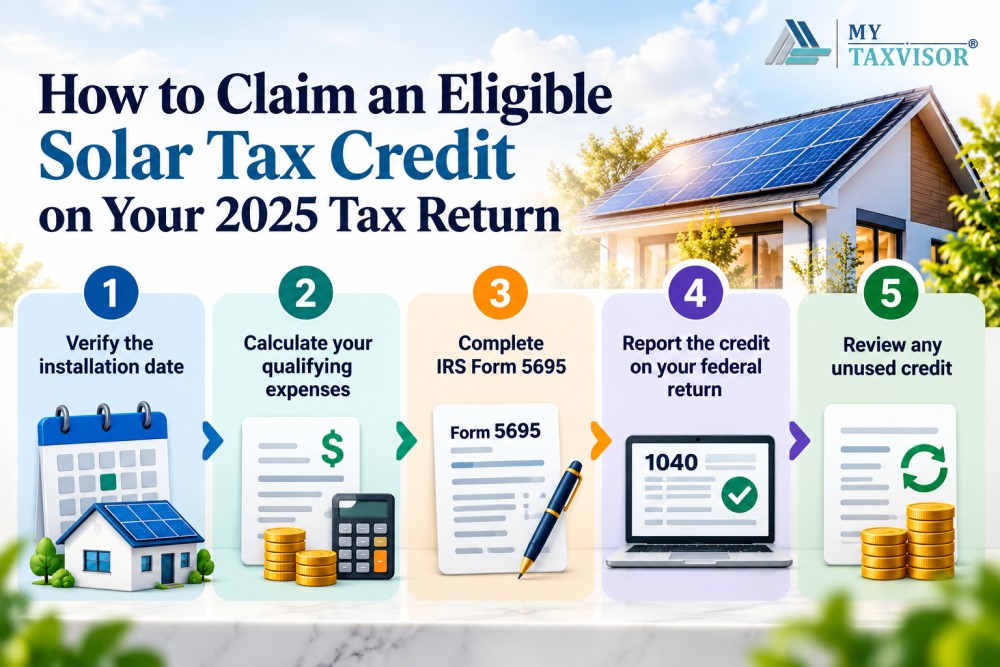
Step 1: Verify the installation date
Check your contract, final invoice, and installation records. Confirm that the original installation was completed within the eligible period. A purchase date or deposit receipt alone is not sufficient.
Step 2: Calculate your qualifying expenses
Review the costs of eligible equipment, installation labor, and related work. Exclude expenses that do not qualify under the IRS rules. Also review whether any rebates or public utility subsidies must be subtracted when calculating eligible expenses.
Step 3: Complete IRS Form 5695
Use Form 5695, Residential Energy Credits, to calculate your eligible residential clean energy credit. The residential clean energy credit is reported in Part I. Follow the applicable form instructions to determine the allowable amount and any unused credit.
Step 4: Report the credit on your federal return
Transfer the allowable credit to the appropriate line of Schedule 3 (Form 1040) and complete your federal income tax return according to the instructions.
You generally do not need to attach ordinary purchase receipts or installation invoices to the return solely to claim the credit. However, you should retain them in case the IRS requests evidence supporting your claim.
Step 5: Review any unused credit
If the allowable credit exceeds the amount you can use under the applicable tax liability limitation, an eligible unused amount may be carried forward. Review the previous year’s Form 5695 and follow the instructions for reporting the carryforward on your current return.
Can You Carry Forward an Unused Solar Tax Credit to 2026?
Yes. An eligible unused Residential Clean Energy Credit from a prior year may be carried forward to reduce federal income tax in 2026, subject to the applicable rules.
The expiration of Section 25D does not automatically eliminate an unused credit that was validly generated under the earlier rules.
For example, suppose a homeowner qualified for a $7,500 credit from a 2025 installation but could use only $5,000 of it against the applicable tax liability limitation.
The remaining $2,500 may be available as a carryforward in 2026. The homeowner cannot treat that amount as a new credit for a solar installation completed in 2026. To check your carryforward:
- Review the tax return for the year the original credit was claimed.
- Check the amount calculated on Form 5695.
- Identify how much of the credit has already been used.
- Confirm the remaining eligible amount.
- Follow the current year’s IRS instructions when filing.
The 2025 Instructions for Form 5695 specifically address carrying unused residential clean energy credit amounts into 2026.
Solar Tax Credit vs. Energy Efficient Home Improvement Credit
The Residential Clean Energy Credit and the Energy Efficient Home Improvement Credit were separate federal tax credits. They covered different types of residential expenses and had different calculation rules.
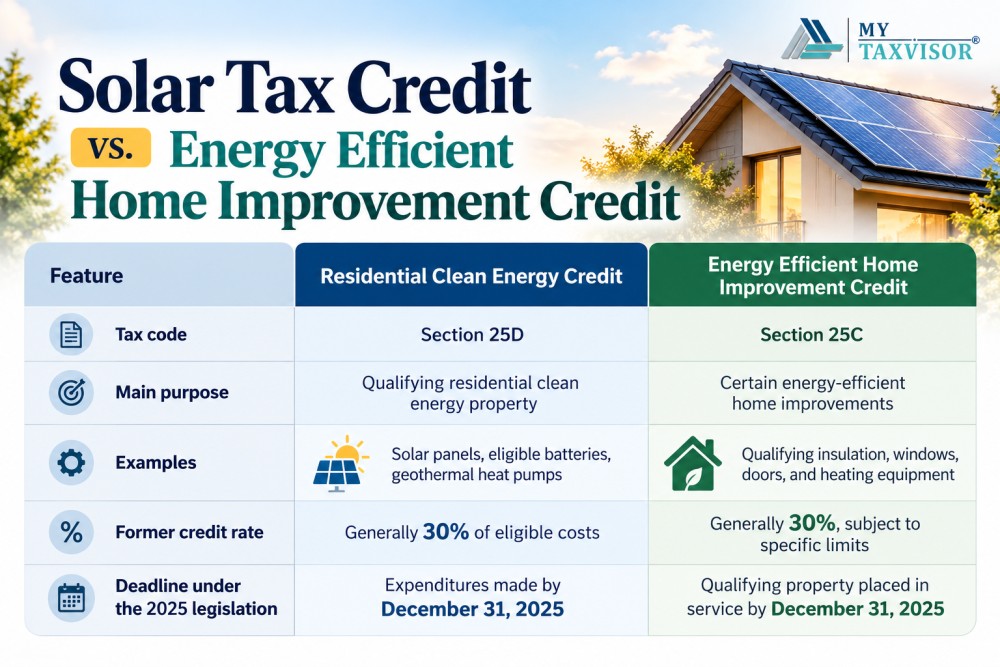
Both credits ended for new qualifying expenses or property beyond their respective deadlines under the 2025 legislation.
A taxpayer who installed solar panels and made other eligible home improvements in 2025 should evaluate each credit separately. The same expense cannot be claimed twice under different provisions.
For readers reviewing other federal tax benefits, MyTaxVisor’s Federal Income Tax Credits article can provide a broader overview of how tax credits differ from deductions and how they affect a federal tax return.
What Should Homeowners Consider Before Installing Solar in 2026?
Although the former federal residential solar tax credit is no longer available for new installations, solar may still make financial sense depending on the household’s energy use, electricity rates, and installation costs.
Before choosing a system, consider the following:
- Total installation cost: Request an itemized quote covering equipment, labor, electrical work, and additional charges.
- Expected electricity savings: Compare projected energy production with your household’s electricity consumption and utility rates.
- Financing costs: Review interest rates, fees, loan terms, and the total amount payable.
- Utility policies: Check net metering, export compensation, interconnection rules, and applicable charges with your electricity provider.
- Other incentives: Check current state, local, and utility programs. Confirm eligibility, deadlines, and available funding directly with the administering authority.
- Ownership arrangements: For a lease or power purchase agreement, review the monthly cost, contract length, price increases, maintenance responsibilities, and home-sale conditions.
Do not subtract the former 30% federal credit from a 2026 installation quote when calculating the project’s expected cost.
Other incentives may still be available, but eligibility depends on the specific program. A solar company or equipment manufacturer may also offer its own promotion, which is separate from a federal income tax credit.
Get Help With Your Solar Tax Credit Filing
If you installed a qualifying solar system in 2025, reviewing the IRS rules and your supporting records can help you determine whether you are entitled to claim the credit on your 2025 federal tax return.
MyTaxVisor can help you understand applicable federal tax requirements, organize your filing information, and review eligible tax credits and carryforwards. Get your solar tax credit eligibility reviewed and your federal tax return prepared with MyTaxVisor. Contact our team for tax filing guidance based on your circumstances.
Frequently Asked Questions
1. Can I claim the credit if my solar panels were installed in December 2025 but my utility approved the system in January 2026?
The key issue is whether the original installation was completed by the deadline. Utility approval or permission to operate is not, by itself, the date specified in the IRS rule for determining when the expenditure was made. Keep your installation records and review the facts of your project before filing.
2. Can I claim the residential solar tax credit if I leased my solar panels?
Generally, no. Under a solar lease, the leasing company owns the equipment, so the homeowner generally cannot claim the former Section 25D credit for that system. The same ownership distinction is important for a power purchase agreement, under which a third party typically owns the equipment.
3. Are solar loan interest payments and loan origination fees included in the credit calculation?
No. Interest paid on a solar loan, including loan origination fees, is not included in qualifying expenses for the Residential Clean Energy Credit. Eligible equipment and installation costs must be calculated separately.
4. Do solar rebates reduce the amount used to calculate the tax credit?
They can. Public utility subsidies generally reduce qualifying expenses. Certain rebates from manufacturers, sellers, distributors, or installers may also reduce eligible costs when they meet the IRS definition of a purchase-price adjustment. The treatment of state incentives can differ, so review the applicable rules before calculating the credit.
5. What happens if I forgot to claim an eligible solar tax credit on my 2025 return?
You may be able to amend your federal income tax return using Form 1040-X, subject to applicable filing deadlines and requirements. Review the IRS instructions and confirm that your original installation and expenses qualified before submitting an amended return.
6. Can I claim the former residential solar tax credit for a battery installed in 2026?
No. The former Section 25D credit is unavailable for new qualifying residential clean energy expenditures made after December 31, 2025. This includes otherwise qualifying battery storage installations completed in 2026. Eligible unused credits from prior years are a separate matter and may still be carried forward.