
The Earned Income Tax Credit (EITC) is a refundable federal tax credit for workers and families with low to moderate incomes. Your credit depends on your earned income, adjusted gross income (AGI), filing status, and number of qualifying children.
For tax year 2026, the maximum credit ranges from $664 for taxpayers without qualifying children to $8,231 for those with three or more qualifying children. You must also meet the IRS requirements for income, Social Security numbers, and filing status. These amounts apply to income earned in 2026 and claimed on a tax return filed in 2027.
What Is the Earned Income Tax Credit (EITC)?
The EITC helps eligible workers reduce their federal tax burden. Because it is refundable, you may receive a refund even if you owe no federal income tax.
The credit increases with earned income up to a certain point. It then decreases as income rises beyond the applicable threshold. Your credit depends on your income, filing status, and qualifying children.
How Much Is the Earned Income Tax Credit for 2026?
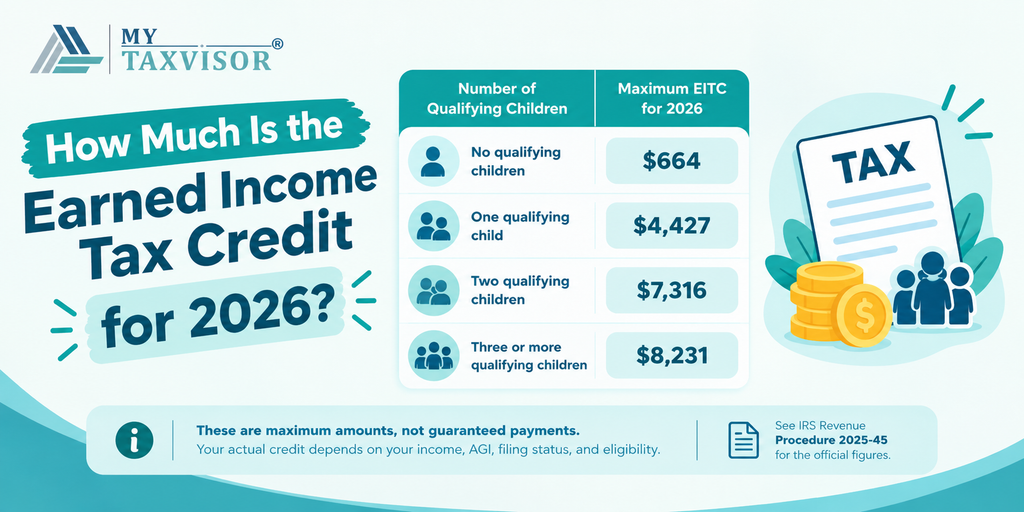
The maximum EITC depends on the number of qualifying children you claim. Taxpayers without qualifying children can also qualify, but their maximum credit is lower.
The IRS has published the following maximum credit amounts for tax year 2026 in Revenue Procedure 2025-45.
| Number of qualifying children | Maximum EITC for 2026 |
| No qualifying children | $664 |
| One qualifying child | $4,427 |
| Two qualifying children | $7,316 |
| Three or more qualifying children | $8,231 |
These are maximum amounts, not guaranteed payments. Your actual credit depends on your income, AGI, filing status, and eligibility.
See IRS Revenue Procedure 2025-45 for the official figures.
What Are the EITC Income Limits for 2026?
To qualify for the EITC, your earned income and AGI must fall within the applicable limits. These limits vary by filing status and number of qualifying children. The IRS also sets an investment income limit.
The following table shows the income thresholds at which the credit reaches zero for tax year 2026. The applicable threshold depends on your filing status and number of qualifying children. The IRS uses whichever is higher: your earned income or AGI.
| Qualifying children | Single, head of household, or other eligible non-joint filers | Married filing jointly |
| None | $19,540 | $26,820 |
| One | $51,593 | $58,863 |
| Two | $58,629 | $65,899 |
| Three or more | $62,974 | $70,244 |
Your credit may start decreasing before you reach the income limit shown above.
For 2026, your qualifying investment income must not exceed $12,200. If it does, you cannot claim the EITC.
How Income Affects Your Credit
The EITC follows three stages as your earned income changes:
- Phase-in: Your credit increases as your eligible earned income rises.
- Maximum-credit range: You may qualify for the full credit once your income reaches the applicable range.
- Phase-out: Your credit decreases as your income rises beyond the threshold, eventually reaching zero.
Check the IRS EITC tables for the applicable figures. Previous years’ limits may differ.
Who Qualifies for the Earned Income Tax Credit in 2026?
To qualify for the EITC, you must meet the IRS rules for income, filing status, Social Security numbers, and residency. Additional requirements apply if you have qualifying children.
In general, you must meet these conditions:
- Have qualifying earned income.
- Meet the applicable earned income and AGI limits.
- Have qualifying investment income of no more than $12,200.
- Have valid Social Security numbers that meet IRS requirements. This applies to you, your spouse if filing jointly, and any qualifying child.
- Generally be a U.S. citizen or resident alien for the entire tax year.
- Not file Form 2555 to claim the foreign earned income exclusion.
Special rules apply to married taxpayers filing separately, separated spouses, and certain other situations. Review the IRS EITC eligibility rules before filing.
EITC Eligibility With Qualifying Children
Your child must meet the IRS relationship, age, residency, and joint return tests to qualify.
- Relationship: The child must be your son, daughter, stepchild, adopted child, eligible foster child, sibling, stepsibling, half-sibling, or a descendant of one of these relatives.
- Age: The child must generally be under 19 at the end of 2026, or under 24 if a full-time student for at least five months of the year. A child who is permanently and totally disabled may qualify at any age.
- Residency: The child must generally have lived with you in the United States for more than half of 2026.
- Joint return: The child generally cannot file a joint return with a spouse, except in limited circumstances.
Only one taxpayer can claim the same child for the EITC. If parents live apart or multiple taxpayers could claim the child, IRS tie-breaker rules determine who qualifies.
For more details, see the IRS qualifying-child rules.
Can You Claim the EITC Without Children?
Yes. You may qualify without qualifying children if you meet the additional requirements. For tax year 2026, you generally must:
- Be at least 25 but under 65 at the end of the year.
- Have lived in the United States for more than half of 2026.
- Have earned income and AGI within the applicable limits.
- Have a valid Social Security number that meets IRS requirements.
- Not be another taxpayer’s qualifying child or dependent.
- Meet all other EITC requirements.
For married couples filing jointly, at least one spouse must meet the age requirement. The maximum EITC without qualifying children is $664.
What Counts as Earned Income for the EITC?
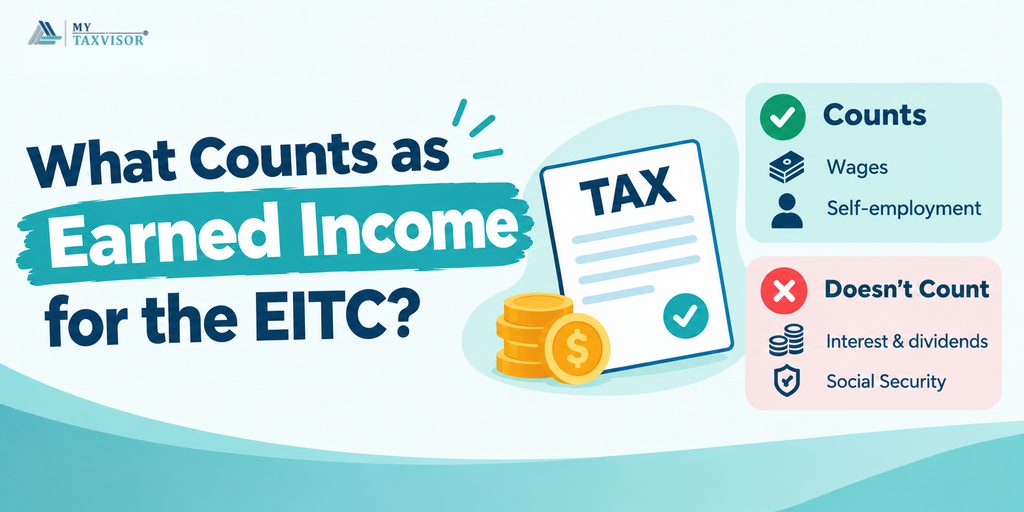
Earned income generally includes taxable wages and net earnings from self-employment. Not all income reported on your tax return counts toward the EITC.
Income that may count:
- Wages, salaries, and tips.
- Taxable household employee wages.
- Net earnings from self-employment, including freelance, gig, and business income.
- Certain disability benefits received before minimum retirement age.
- Certain nontaxable combat pay, if you elect to include it.
Income that generally does not count:
- Interest and dividends.
- Pensions and annuities.
- Social Security benefits.
- Unemployment compensation.
- Alimony.
- Child support.
If you are self-employed, report your business income and allowable expenses accurately. Special rules apply to certain disability benefits and combat pay. See the IRS Earned Income Credit guidance for details.
How Is the Earned Income Tax Credit Calculated?
The IRS calculates your EITC using your earned income, AGI, filing status, and number of qualifying children. Your credit depends on where your income falls within the applicable ranges.
The calculation has three stages:
- Phase-in: Your credit increases as your earned income rises.
- Maximum-credit range: You may qualify for the full credit once your income reaches the applicable range.
- Phase-out: Your credit decreases when your income exceeds the threshold, eventually reaching zero.
The calculation also considers whether your earned income or AGI is higher. Your investment income must remain within the annual limit.
Use the IRS EITC Assistant to check your eligibility and estimate your credit. You may qualify for less than the maximum amount, even if your income falls below the upper limit.
How Do You Claim the EITC in 2026?
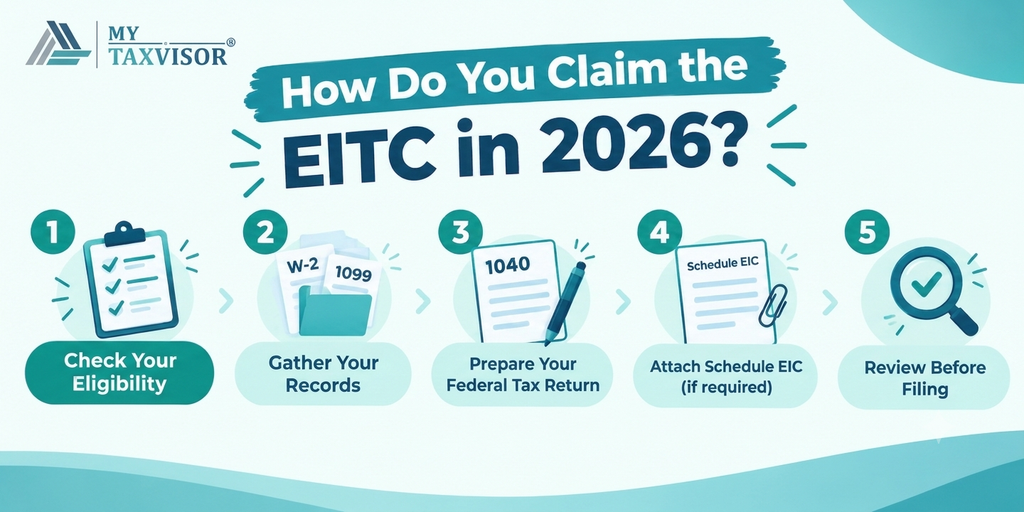
If you earn income during 2026, you generally claim the EITC when filing your federal tax return in 2027. Follow these steps:
1. Check your eligibility
Review your income, filing status, investment income, and qualifying-child details against the 2026 requirements.
2. Gather your records
Collect Forms W-2 and 1099, self-employment income and expense records, and documents supporting your qualifying child’s eligibility.
3. Prepare your federal tax return
Complete Form 1040 or Form 1040-SR using the applicable tax-year instructions. See the IRS Form 1040 page for the relevant forms and instructions.
4. Attach Schedule EIC if required
If you claim the credit with a qualifying child, complete and attach Schedule EIC. You generally do not need this schedule if you claim the EITC without a qualifying child.
5. Review before filing
Check Social Security numbers, income figures, filing status, and qualifying-child information. Errors can delay your refund or affect your credit.
If you need help preparing your return, explore MyTaxVisor’s tax preparation services.
When Will You Receive Your EITC Refund?
The IRS cannot issue refunds for returns claiming the EITC before mid-February. This applies to your entire refund, not just the EITC portion.
Errors or requests for additional information can cause further delays. For the 2027 filing season, check the IRS refund guidance for updates.
After filing, use the official Where’s My Refund? tool to check your refund status.
Common EITC Mistakes to Avoid
These mistakes can delay your refund or affect your eligibility:
- Claiming an ineligible child: Check the relationship, age, residency, and joint return requirements.
- Reporting incorrect income: Report the income required under IRS rules, including applicable self-employment earnings.
- Using the wrong filing status: Make sure your filing status meets the EITC rules.
- Overlooking investment income: Your qualifying investment income must not exceed $12,200 for 2026.
- Entering incorrect Social Security information: Check names and numbers against official records.
- Using outdated limits: Use the figures for 2026, not those from previous years.
- Failing to keep records: Keep income documents and records supporting your qualifying child’s eligibility.
See the IRS guidance on claiming the EITC for more information.
Get Professional Help With Your Earned Income Tax Credit Claim
Your EITC depends on your income, filing status, and eligibility. Mistakes involving income or qualifying children can reduce your credit or delay your refund.
MyTaxVisor helps individuals and families prepare federal tax returns and review credit eligibility. Contact MyTaxVisor for help reviewing your tax situation and preparing your return.
Frequently Asked Questions About the Earned Income Tax Credit 2026
Can I qualify for the EITC if I work part-time?
Yes. Part-time workers may qualify if they have eligible earned income and meet the other requirements. Your credit depends on your income, filing status, and qualifying children.
I am self-employed. Can I claim the EITC without a W-2?
Yes. Self-employed taxpayers may qualify based on their net earnings from business or freelance work. You must report your business income and allowable expenses accurately.
Can I claim the EITC if my child lived with me for only part of 2026?
Possibly. Your child generally must have lived with you in the United States for more than half of 2026. Exceptions may apply to certain temporary absences and children born or who died during the year.
Can I claim the EITC if I am married but file separately?
Some separated spouses may qualify under special IRS rules, particularly when a qualifying child lives with them and they meet the separation requirements. Filing separately does not automatically make you eligible.
What if I qualified for the EITC but did not claim it on my tax return?
You may be able to claim the credit by filing an amended return. The deadline depends on the tax year and applicable refund-claim rules. Check the IRS instructions before amending a previous return.
Can I claim the EITC and the Child Tax Credit on the same return?
Yes. You can claim both credits if you meet the eligibility requirements for each. Qualifying for the EITC does not automatically make you eligible for the Child Tax Credit.