
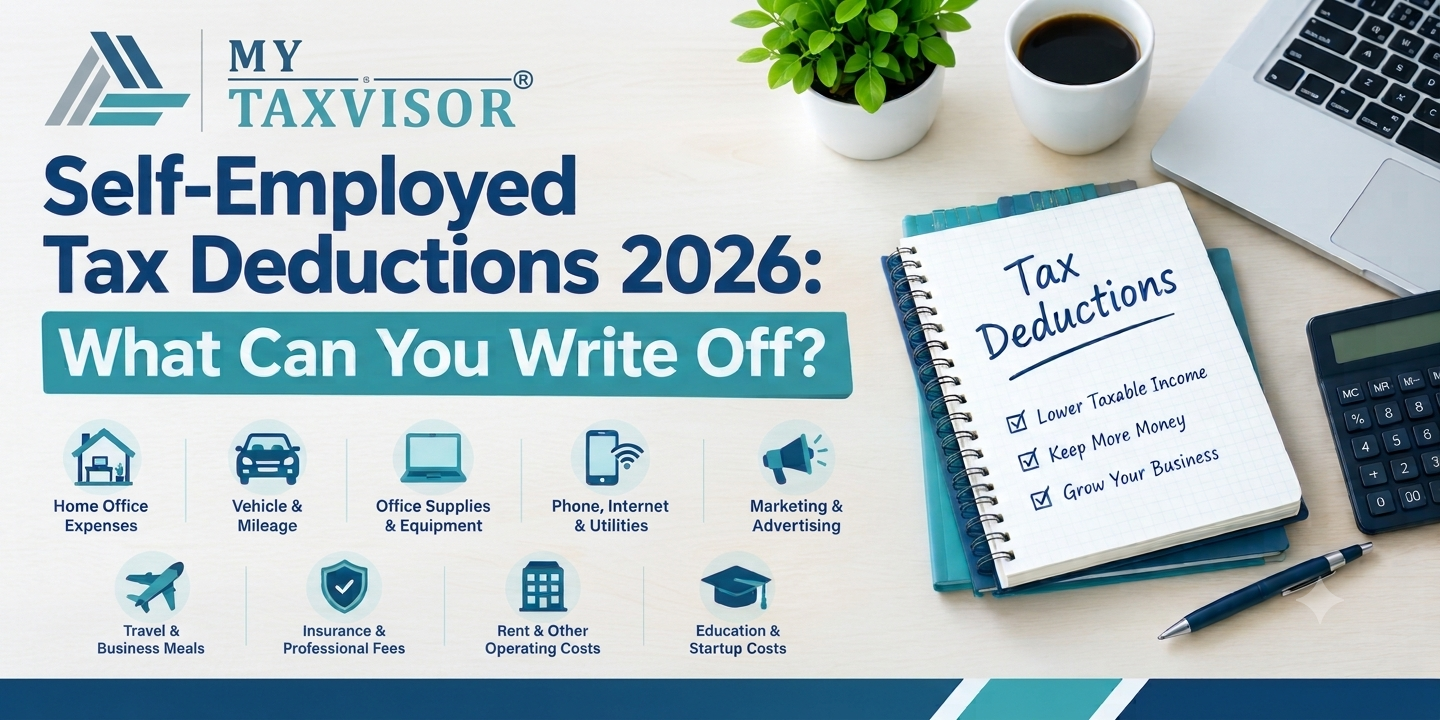
Self-employed individuals can deduct eligible business expenses when calculating their business profit. These deductions may reduce federal income tax, but each expense must meet IRS requirements.
Freelancers, independent contractors, consultants, gig workers, and sole proprietors may qualify for deductions on home office costs, vehicle use, equipment, travel, insurance, and other business expenses. Additional deductions may apply to health insurance, retirement contributions, and self-employment tax.
This guide explains self-employed tax deductions for 2026, including eligible expenses, deduction limits, reporting rules, and costs that generally do not qualify.
What Are Self-Employed Tax Deductions?
Self-employed tax deductions are eligible expenses and adjustments that reduce taxable income under federal tax rules. Business expense deductions generally reduce net business profit, while certain other deductions are calculated separately on the individual tax return.
How Business Deductions Work
You generally calculate business profit by subtracting allowable business expenses from business income. For example, a business with $80,000 in income and $15,000 in deductible expenses has $65,000 in net profit before other applicable adjustments.
To qualify, a business expense generally must be ordinary and necessary for the business. An ordinary expense is common and accepted in the relevant trade or business. A necessary expense is helpful and appropriate for its operation.
A deduction reduces taxable income; it does not usually reduce the tax bill dollar for dollar. The expense must also be classified correctly. Some costs can be deducted in the year paid or incurred, while equipment, improvements, and certain other expenditures may need to be recovered over time.
Who Can Claim Them?
Self-employed tax deductions may be available to individuals operating a business or earning income through independent work. This can include:
- Freelancers and consultants.
- Independent contractors and gig workers.
- Sole proprietors and eligible single-member LLC owners.
- Individuals running a business alongside employment.
Your business structure and tax-reporting method determine which rules and forms apply. Receiving Form 1099 does not automatically make every expense deductible. You must report taxable income and support the expenses claimed on your return.
What Expenses Can You Deduct When Self-Employed in 2026?
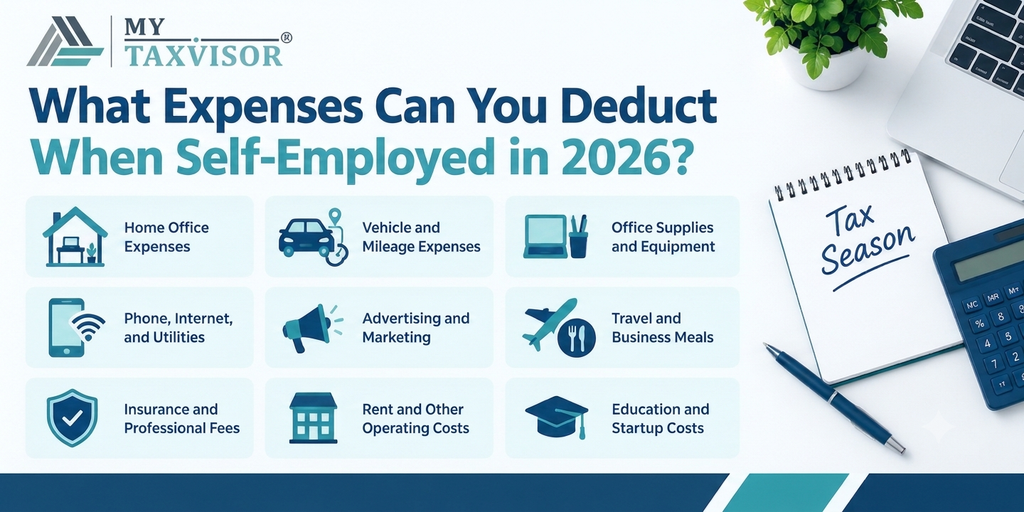
You may deduct qualifying costs incurred to operate your business. The rules below explain the main categories and the restrictions that can affect your claim.
Home Office Expenses
You may qualify for a home office deduction if you use part of your home regularly and exclusively for a qualifying business purpose. Occasional remote work does not automatically qualify.
You can generally use the simplified or regular method. The simplified method allows $5 per square foot of qualifying space, up to 300 square feet, for a maximum deduction of $1,500.
The regular method uses eligible home expenses and the percentage of your home used for business. It requires more detailed calculations.
Review the IRS rules for the simplified home office deduction.
Vehicle and Mileage Expenses
If you use a vehicle for business, you may deduct eligible costs using the standard mileage method or the actual-expense method, subject to IRS rules. You generally cannot combine the methods to deduct the same costs twice.
For 2026, the standard business mileage rates are:
- 72.5 cents per mile from January 1 through June 30.
- 76 cents per mile from July 1 through December 31.
Keep a mileage log showing the date, destination, business purpose, and miles driven. Personal driving and ordinary commuting generally do not qualify.
Check the IRS standard mileage rates before calculating your deduction.
Office Supplies and Equipment
Qualifying supplies may include paper, printer ink, shipping materials, and other items used to run your business.
Computers, furniture, machinery, and other equipment may qualify for immediate expensing or depreciation, depending on the item and applicable rules. Business software may also qualify, but mixed personal and business use must be allocated appropriately.
Keep purchase records to support your claims.
Phone, Internet, and Utilities
You may deduct the business portion of phone, internet, and other eligible utility costs. If you use a service for both work and personal activities, calculate the business portion using a reasonable method.
Do not claim utility costs twice if they are already included in your home office deduction.
Advertising and Marketing
Qualifying business promotion costs may include online advertising, website hosting, design services, business listings, and promotional materials.
The expense must relate to your business. Keep invoices or payment records showing what the service covered.
Travel and Business Meals
You may deduct eligible travel costs when business requires you to travel away from your tax home. Qualifying expenses may include transportation, lodging, and related costs.
Personal vacations are not deductible. If a trip combines business and personal activities, separate the eligible business expenses from personal costs.
Business meals are generally subject to a 50% deduction limit, although exceptions apply.
See IRS Publication 463, Travel, Gift, and Car Expenses for the applicable rules.
Insurance and Professional Fees
Eligible business insurance may include liability coverage and insurance for business property. You may also deduct qualifying fees for accounting, bookkeeping, legal advice, and other professional services related to your business.
Personal professional fees generally do not qualify. Self-employed health insurance follows separate rules, explained below.
Rent and Other Operating Costs
Rent for a qualifying business office, studio, or workspace may be deductible. Other eligible operating expenses may include payment-processing fees and business bank fees.
Costs associated with buying property may require different treatment, such as depreciation. Review each expense under the applicable rules.
Education and Startup Costs
Education may qualify when it maintains or improves skills needed for your existing business. Training that qualifies you for a new trade or business generally does not qualify under the same rules.
Some costs incurred before a business begins operating may qualify for a deduction or amortization. Treatment depends on the type of startup cost and the applicable requirements.
What Other Tax Deductions Can Self-Employed Individuals Claim?
Some deductions are claimed separately from ordinary business expenses. They have their own eligibility requirements and may affect your individual tax return differently.
Deduction for Self-Employment Tax
Self-employed individuals generally pay self-employment tax on qualifying net earnings. You may deduct the employer-equivalent portion when calculating adjusted gross income.
This deduction reduces income subject to federal income tax. It does not eliminate the self-employment tax itself.
See the IRS instructions for Schedule SE.
Self-Employed Health Insurance
Eligible self-employed individuals may deduct qualifying health insurance premiums for themselves, their spouse, and eligible dependents.
The deduction is subject to restrictions, including limits based on eligible business income. Eligibility may also depend on access to an employer-sponsored health plan.
This is generally an adjustment to income, not an ordinary Schedule C expense. Review the IRS self-employed tax resources for the applicable requirements.
Retirement Plan Contributions
Self-employed individuals may qualify for deductions for contributions to eligible retirement plans, including SEP-IRAs and individual 401(k) plans.
The allowable amount depends on the plan, eligible earnings, and annual limits. For 2026, the maximum SEP contribution is $72,000, subject to compensation limits and plan rules. Your actual allowable contribution may be lower.
Check the IRS guidance on SEP contribution limits and retirement plan contribution limits.
Qualified Business Income Deduction
Eligible self-employed taxpayers may qualify for the qualified business income (QBI) deduction. It is separate from ordinary business expenses and does not provide an additional deduction for every expense claimed on Schedule C.
Eligibility and the amount depend on factors such as taxable income, business type, wages, qualified property, and other applicable limitations.
Review the IRS Qualified Business Income Deduction guidance and the current instructions for Form 8995 or Form 8995-A.
Which Self-Employed Expenses Are Not Tax-Deductible?
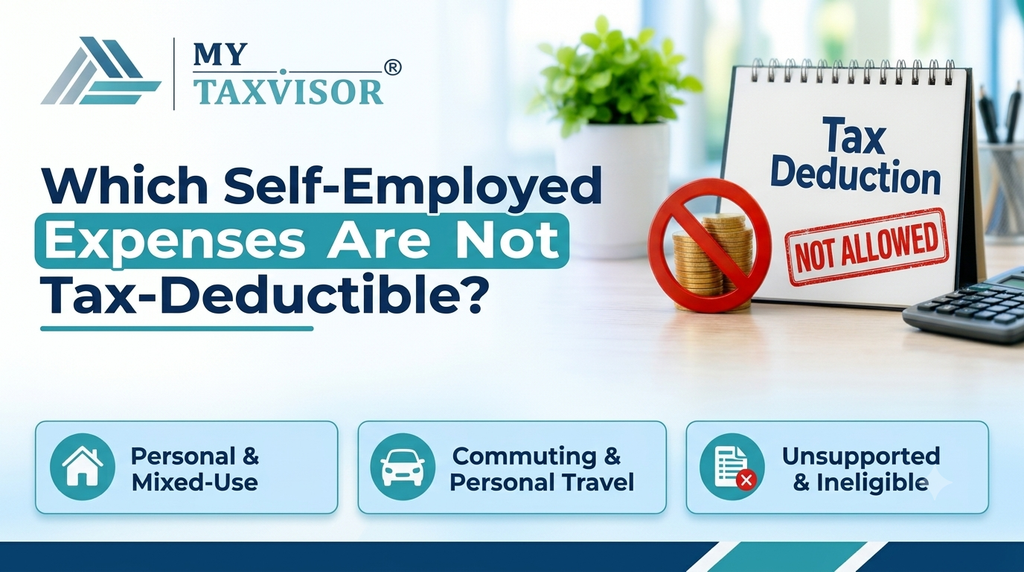
Personal costs, unsupported claims, and expenses unrelated to your business generally do not qualify.
Personal and Mixed-Use Expenses
Personal shopping, family expenses, and other personal costs are generally not deductible as business expenses. For items or services used for both business and personal purposes, claim only the eligible business portion.
Commuting and Personal Travel
Travel between your home and a regular workplace is generally commuting, not deductible business travel. Personal vacations are also not deductible simply because you discuss business during the trip.
For trips that combine business and personal activities, allocate the costs according to the applicable rules.
Unsupported or Ineligible Expenses
An expense may be disallowed if it does not qualify or lacks adequate documentation. A bank statement can show that you paid an amount, but it may not establish the business purpose.
Keep relevant receipts, invoices, mileage logs, and contracts to support your claims.
How Do You Calculate and Claim Self-Employed Tax Deductions?
To claim deductions correctly, identify eligible expenses, calculate the deductible amount, and report each item on the appropriate form.
Calculate Your Deductible Expenses
Review your business income and expenses for the tax year. Separate personal costs and calculate the business portion of mixed-use expenses.
Apply the correct method for vehicle costs and equipment purchases. Check the separate requirements for health insurance, retirement contributions, self-employment tax, and the QBI deduction.
Report Expenses on the Correct Forms
Many sole proprietors report business income and expenses on Schedule C with their individual federal tax return. Self-employment tax is generally calculated on Schedule SE.
Other deductions may be reported elsewhere on the return. Do not assume that every deduction belongs on Schedule C.
Use the IRS Schedule C instructions to confirm reporting requirements.
Keep Records to Support Your Claims
Keep records showing the amount of each expense and its business purpose. Depending on the deduction, these may include:
- Receipts and invoices.
- Mileage logs.
- Phone and internet bills.
- Business-use calculations.
- Contracts and professional-service invoices.
- Equipment purchase records.
- Insurance and retirement contribution records.
Organized records help support your deductions and prepare an accurate return.
What Changed for Self-Employed Tax Deductions in 2026?
Several annual figures relevant to self-employed taxpayers changed or apply specifically to 2026. These include the business mileage rates and retirement contribution limits discussed above.
The IRS also lists the maximum net self-employment earnings subject to the Social Security portion of self-employment tax as $184,500 for 2026. This affects the tax calculation, not the amount of ordinary business expenses you can deduct.
Check the current IRS guidance for each deduction before filing. Do not rely on prior-year figures when preparing a 2026 return.
Get Help With Your Self-Employed Tax Deductions
Self-employed tax deductions depend on the nature of your business, how expenses are used, and the rules that apply to each claim. Incorrect classifications, missed limits, and inadequate records can lead to inaccurate tax returns or deductions that cannot be substantiated.
MyTaxVisor can help you organize business expenses, assess potentially eligible deductions, and prepare your tax return based on your circumstances. If you need help reviewing your self-employed tax situation, contact MyTaxVisor to schedule a consultation.
Frequently Asked Questions About Self-Employed Tax Deductions 2026
Can I Claim Tax Deductions if My Self-Employed Business Made a Loss?
You may still have eligible business expenses when your business operates at a loss. However, tax rules can limit how much of the loss you can use and when you can claim it. The result depends on your circumstances.
Can I Deduct Expenses I Paid Before My Business Started?
Some startup costs may qualify for a deduction or amortization. The treatment depends on the type of expense and when business operations began. Keep records that separate startup costs from later operating expenses.
Can I Claim the Same Expense as Both a Business Deduction and a Personal Deduction?
Generally, no. You cannot deduct the same expense twice. If a cost has both business and personal uses, allocate it according to the applicable rules.
Do I Need Receipts for Every Self-Employed Tax Deduction?
You need records that support your claims. Depending on the expense, these may include receipts, invoices, mileage logs, contracts, or other documents. A payment record alone may not establish the business purpose.
Can I Claim Self-Employed Tax Deductions Without Itemizing?
Yes. Many business expenses are reported on Schedule C, while certain other deductions are claimed elsewhere on your individual return. These are different from itemized deductions on Schedule A.