
The Child Tax Credit (CTC) can reduce federal income tax for eligible parents and guardians. For tax year 2026, the maximum credit is $2,200 per qualifying child. Eligible taxpayers may also qualify for a refundable portion through the Additional Child Tax Credit (ACTC).
Eligibility depends on your income, filing status, child’s age, relationship, residency, and Social Security number. Understanding these requirements can help you determine whether you qualify.
What Is the Child Tax Credit?
The Child Tax Credit is a federal tax credit for taxpayers with qualifying children. Unlike a deduction, which reduces taxable income, a tax credit directly reduces your federal income tax liability.
The regular CTC is generally nonrefundable. If you qualify, the ACTC may allow you to receive a refund for part of the unused credit, subject to separate requirements. See the IRS’s Child Tax Credit guidance for details.
How Much Is the Child Tax Credit in 2026?
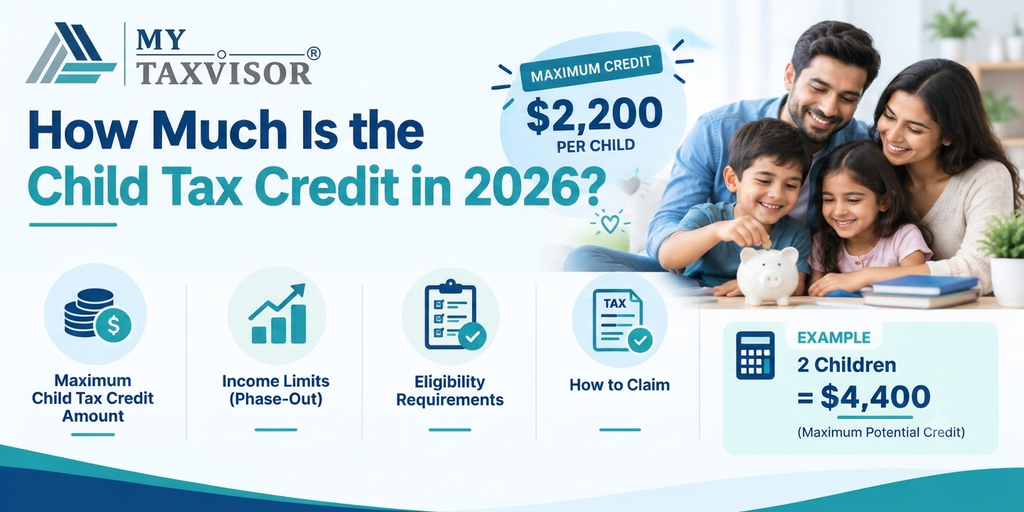
For tax year 2026, the maximum CTC is $2,200 per qualifying child under the current IRS draft instructions. Your actual credit may be lower because of income limits, eligibility rules, or tax liability.
Maximum Child Tax Credit Amount
The maximum credit is $2,200 per qualifying child. It generally begins to phase out when modified adjusted gross income (MAGI) exceeds $200,000 for most filing statuses or $400,000 for married couples filing jointly.
The regular CTC can reduce your federal income tax to zero but generally cannot create a refund by itself. You may qualify for the refundable ACTC if you meet its requirements.
The IRS’s 2026 draft Instructions for Schedule 8812 provide the current figures. Confirm them against the final instructions before publication.
Example: Calculating Your Potential Child Tax Credit
Suppose you have two qualifying children and meet all other eligibility requirements.
First child: $2,200
Second child: $2,200
Maximum potential credit: $4,400
Your actual credit may be lower because of income phaseouts, tax liability, or other applicable limitations.
Who Qualifies for the Child Tax Credit in 2026?
You and your child must meet the IRS eligibility requirements. These include age, relationship, dependency, residency, and Social Security number rules.
Age and Relationship Requirements
A qualifying child generally must be under age 17 at the end of 2026. A child who turns 17 during the year generally does not qualify for the CTC.
Eligible relationships generally include:
- Son or daughter
- Stepchild
- Eligible foster child
- Brother or sister, including half-siblings and stepsiblings
- Descendants such as grandchildren, nieces, or nephews
The child must also meet the remaining eligibility requirements. An older dependent may qualify for the Credit for Other Dependents instead.
Dependency and Residency Requirements
You generally must claim the child as a dependent, and the child must have lived with you in the United States for more than half of the tax year.
Certain temporary absences, such as time away for school or medical care, may count as time lived with you. Special rules apply to some children born during the year and to divorced or separated parents.
The child generally must not have provided more than half of their own support. Limited exceptions may apply to other qualifying-child tests.
For additional details, see the IRS’s Publication 501: Dependents, Standard Deduction, and Filing Information.
Citizenship and Social Security Number Requirements
The child generally must be a U.S. citizen, U.S. national, or U.S. resident alien and have a valid Social Security number (SSN) for employment that meets IRS timing requirements.
An Individual Taxpayer Identification Number (ITIN) for the child does not satisfy the SSN requirement for the CTC or ACTC.
For a joint return, generally one spouse must have a valid SSN, while the other must have an SSN or ITIN issued by the applicable filing deadline.
Special Eligibility Situations
Some family circumstances require additional review.
Child born in 2026: The child may qualify if the applicable requirements are met, including the rules for residency during the year of birth.
Temporary absences: Certain absences may count toward the residency test.
Divorced or separated parents: IRS custody and claim-release rules determine which parent may claim the credit.
Do not assume eligibility based solely on financial support or a custody agreement. Apply the relevant IRS rules to your circumstances.
What Are the Child Tax Credit Income Limits for 2026?
Your modified adjusted gross income (MAGI) determines whether your credit is reduced. Taxpayers above the applicable threshold may still qualify for a partial credit.
Income Thresholds and Phaseout Rules
According to the IRS draft instructions for Schedule 8812 for 2026, the Child Tax Credit begins to phase out when modified adjusted gross income (MAGI) exceeds these thresholds:
| Filing Status | Income Threshold |
| Single | $200,000 |
| Head of household | $200,000 |
| Married filing separately | $200,000 |
| Married filing jointly | $400,000 |
Note: These figures are based on draft IRS instructions and should be verified against the final instructions before publication.
How Income Affects Your Credit
The credit generally decreases by $50 for every $1,000, or fraction of $1,000, that your MAGI exceeds the applicable threshold.
Example: A married couple filing jointly has a MAGI of $410,000 and two qualifying children. Their income exceeds the $400,000 threshold by $10,000, resulting in a potential $500 reduction.
The final credit depends on the complete calculation and the taxpayers’ eligibility.
What Is the Additional Child Tax Credit (ACTC)?
The Additional Child Tax Credit is the refundable portion of the CTC. Eligible taxpayers may receive a refund for part of the credit they cannot use to reduce their federal income tax.
Under the current 2026 IRS draft instructions, the maximum ACTC is $1,700 per qualifying child. Confirm this amount against the final instructions before publication.
Who Qualifies for the Refundable Portion?
You may qualify for the ACTC if you:
- Have a qualifying child who meets the applicable CTC requirements.
- Meet the required Social Security number rules.
- Have sufficient earned income under the applicable calculation.
- File the required tax return and complete Schedule 8812.
The standard earned-income formula generally requires more than $2,500 in earned income. Other eligibility and calculation rules apply.
How the Additional Child Tax Credit Is Calculated
The ACTC depends on your earned income, the unused eligible CTC, and the number of qualifying children.
Under the standard formula, the calculation generally uses 15% of earned income above $2,500, subject to applicable limits.
Example:
A taxpayer has $20,000 in earned income and one qualifying child.
Earned income: $20,000
Income above $2,500: $17,500
15% of $17,500: $2,625
The ACTC is not automatically $2,625. The refundable amount is limited by the eligible unused credit and the maximum allowed per qualifying child.
What Is the Credit for Other Dependents?
The Credit for Other Dependents (ODC) is a nonrefundable credit for eligible dependents who do not qualify for the CTC.
The maximum ODC is generally $500 per eligible dependent, subject to applicable income and eligibility rules.
You may qualify for the ODC for:
- A child who is too old to qualify for the CTC.
- A qualifying relative who meets the dependency requirements.
- A dependent who does not meet the CTC’s SSN requirement but satisfies the ODC identification rules.
The credit can reduce your federal income tax but cannot create a refund by itself.
Can Divorced or Separated Parents Claim the Child Tax Credit?
Generally, the custodial parent, the parent with whom the child lived for the greater number of nights during the year, may claim the child, subject to IRS rules and exceptions.
A divorce decree or child support arrangement does not automatically determine who can claim the credit.
In qualifying situations, the custodial parent can release the claim to the noncustodial parent using Form 8332 or an applicable statement that meets IRS requirements.
The release does not transfer every child-related tax benefit. For example, the noncustodial parent generally cannot use it to claim head-of-household status or the Earned Income Tax Credit based on that child.
Parents should review the IRS requirements before filing to avoid conflicting claims.
How Do You Claim the Child Tax Credit in 2026?
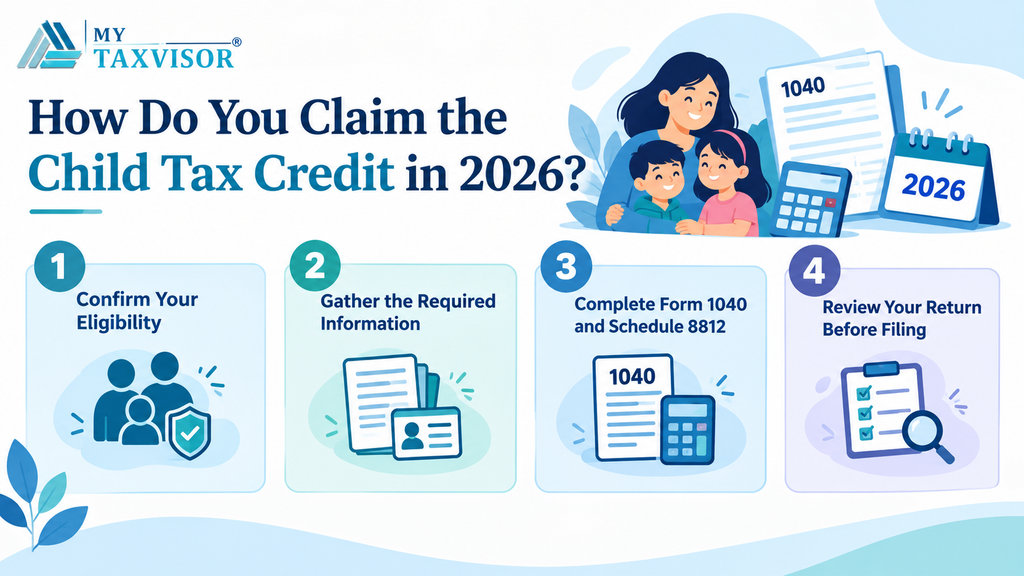
To claim the credit for tax year 2026, you generally file your federal income tax return in 2027. Follow these steps to prepare your claim.
1. Confirm Your Eligibility
Check your child’s age, relationship, residency, dependency status, and SSN. Review your filing status and MAGI to determine whether the income phaseout applies.
2. Gather the Required Information
Prepare:
- Your taxpayer identification information.
- Each qualifying child’s name and SSN.
- Income records and filing-status information.
- Residency or dependency records, if needed.
- Form 8332 or relevant custody documents, if applicable.
Keep supporting documents in case the IRS requests them.
3. Complete Form 1040 and Schedule 8812
Report your income on Form 1040 and use Schedule 8812 to calculate the CTC, ACTC, and ODC, as applicable.
Use the forms and instructions for tax year 2026, not a prior year’s version. The IRS provides the relevant forms and updates on its Schedule 8812 information page.
4. Review Your Return Before Filing
Before submitting your return, confirm that:
- Names and SSNs are correct.
- Your filing status and income are accurate.
- Each child meets the eligibility requirements.
- You have applied for any income phaseout.
- Your Schedule 8812 calculations are correct.
Errors can delay processing or result in an incorrect credit.
Common Child Tax Credit Mistakes to Avoid
Avoid these common errors when preparing your return:
- Using outdated rules: Check the forms and limits for tax year 2026.
- Claiming an ineligible child: Verify age, relationship, residency, and dependency requirements.
- Using an ITIN instead of a required SSN: The CTC and ACTC generally require a qualifying child’s valid SSN.
- Ignoring income phaseouts: Higher MAGI may reduce your credit.
- Assuming the full credit is refundable: The regular CTC is generally nonrefundable; the ACTC may provide a refund if you qualify.
- Claiming a child incorrectly after separation: Follow the IRS rules for divorced or separated parents.
- Entering incorrect information: Check all identification numbers and income figures.
- Omitting Schedule 8812: This schedule is generally used to calculate the CTC, ACTC, and ODC.
Get Professional Help With Your Child Tax Credit Claim
Claiming the Child Tax Credit requires careful review of your income, filing status, dependent eligibility, and applicable IRS rules. Errors in these areas can lead to an incorrect credit amount or delays in processing your return.
MyTaxVisor provides individual tax preparation services to help you assess your eligibility, identify applicable tax credits, and prepare your federal tax return accurately. Whether you have questions about the CTC, ACTC, or dependent-related tax benefits, professional guidance can help you understand your options.
Ready to claim your Child Tax Credit with confidence? Contact MyTaxVisor today to schedule a consultation and get professional support with your tax return.
Frequently Asked Questions About the Child Tax Credit 2026
1. Can I Claim the Child Tax Credit for Two Children?
Yes. If both children qualify, you may claim up to $4,400 before income phaseouts and other applicable limitations.
2. Does the Child Tax Credit Increase My Tax Refund?
It may. The nonrefundable credit can reduce your tax liability, while eligible taxpayers may receive a refund through the Additional Child Tax Credit.
3. Can I Claim the Child Tax Credit if My Child Has an ITIN Instead of an SSN?
No. A qualifying child generally needs a valid SSN for employment to qualify for the CTC or ACTC.
4. When Will I Receive My Refund if I Claim the Additional Child Tax Credit?
The IRS generally cannot issue refunds for returns claiming the ACTC before mid-February. Actual timing depends on return processing.
5. Can I Claim the Child Tax Credit for My 16-Year-Old in 2026?
Yes. Your child may qualify if they are under 17 at the end of 2026 and meet the other eligibility requirements.
6. Do I Need to File a Tax Return to Claim the Child Tax Credit?
Yes. You must file a federal income tax return and complete the required credit calculations to claim the CTC or ACTC.