
Education expenses can be costly, but eligible taxpayers may qualify for federal tax credits to offset some of those costs. The two main options are the American Opportunity Tax Credit (AOTC), worth up to $2,500 per eligible student, and the Lifetime Learning Credit (LLC), worth up to $2,000 per tax return.
Your eligibility depends on your income, filing status, education expenses, and the student’s enrollment.
This guide covers education tax credits for 2026, including credit amounts, eligibility requirements, income limits, qualifying expenses, and how to claim them.
What Education Tax Credits Are Available in 2026?
The AOTC and LLC help eligible taxpayers pay for higher education expenses. Their benefits and eligibility requirements differ.
| Feature | American Opportunity Tax Credit (AOTC) | Lifetime Learning Credit (LLC) |
| Maximum credit | $2,500 per eligible student | $2,000 per tax return |
| Refundable portion | Up to $1,000 may be refundable | Nonrefundable |
| Eligible education | First four years of higher education | Undergraduate, graduate, and eligible job-skills courses |
| Enrollment requirement | At least half-time | At least one eligible course |
| Duration | Maximum of four tax years per student | No fixed year limit |
| Income phaseout | 80,000–90,000 for most non-joint filers; 160,000–180,000 for joint filers | Same income limits |
You cannot claim both credits for the same student in the same tax year. However, different students on the same return may qualify for different credits.
See the IRS education credits overview for official eligibility details.
American Opportunity Tax Credit (AOTC): Amount and Eligibility
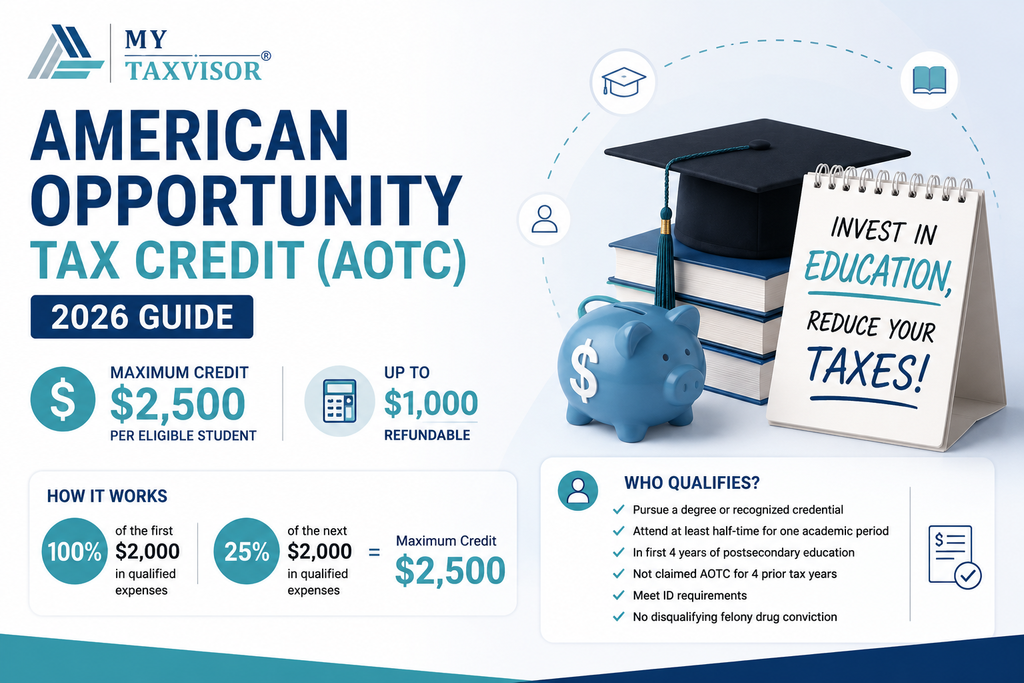
The AOTC provides tax relief for eligible students during their first four years of higher education. It offers a maximum credit of $2,500 per student.
How Much Is the AOTC Worth in 2026?
The AOTC is calculated as follows:
- 100% of the first $2,000 in qualified expenses.
- 25% of the next $2,000 in qualified expenses.
You need at least $4,000 in qualified expenses to receive the maximum $2,500 credit.
For example, $3,000 in eligible expenses produces a calculated credit of $2,250, before any income-related reduction or other applicable limitations.
Up to 40% of the allowed credit, or $1,000, may be refundable. Special restrictions apply to certain taxpayers.
Who Qualifies for the AOTC?
The student generally must:
- Pursue a degree or recognized educational credential.
- Attend at least half-time for one academic period beginning in the tax year.
- Not have completed the first four years of postsecondary education before 2026.
- Not have had the AOTC claimed for them for four prior tax years.
- Meet applicable identification requirements.
- Not have a disqualifying felony drug conviction under the AOTC rules.
The credit may cover eligible expenses for yourself, your spouse on a joint return, or a dependent you claim. Your income must also fall within the applicable limits.
Lifetime Learning Credit (LLC): Amount and Eligibility
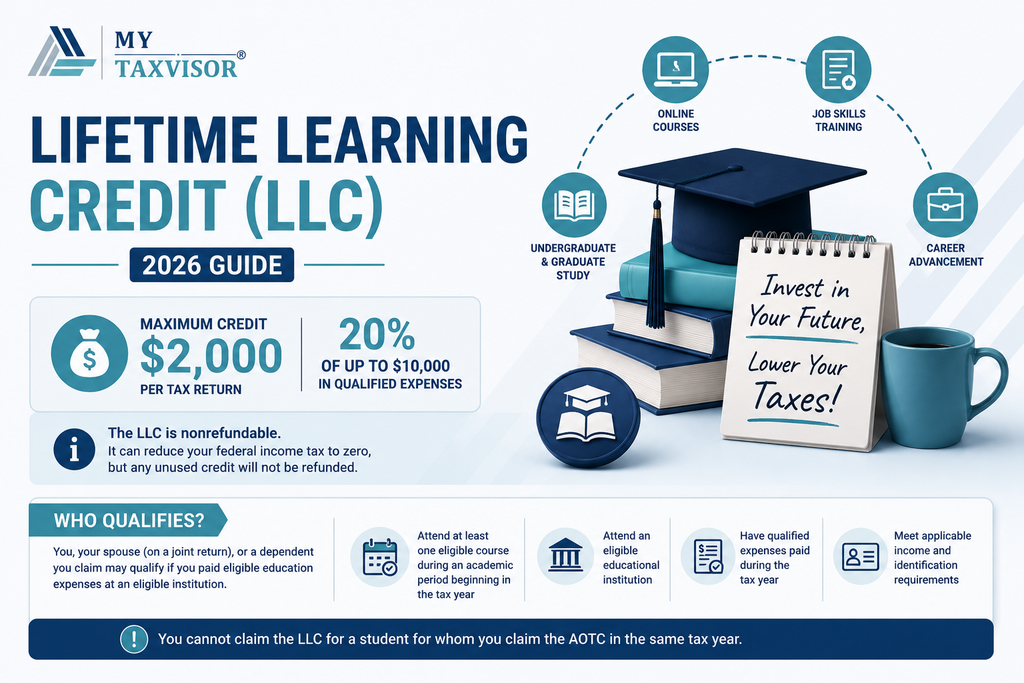
The LLC covers eligible education expenses for undergraduate and graduate study, as well as certain courses taken to acquire or improve job skills. Students do not need to pursue a degree or attend classes at least half-time.
How Much Is the LLC Worth in 2026?
The LLC equals 20% of up to $10,000 in qualified expenses, with a maximum of $2,000 per tax return.
For example, $5,000 in qualified expenses may produce a $1,000 credit before any income-related reduction.
The LLC is nonrefundable. It can reduce your federal income tax to zero, but any unused credit will not be refunded. There is no fixed limit on the number of years you can claim it, provided you meet the requirements each year.
Who Qualifies for the LLC?
You may qualify if you, your spouse on a joint return, or a dependent you claim paid eligible education expenses at an eligible institution.
The student must generally:
- Attend at least one eligible course during an academic period beginning in the tax year.
- Attend an eligible educational institution.
- Have qualified expenses paid during the tax year.
- Meet applicable income and identification requirements.
The student does not need to be enrolled in a degree program or attend half-time. You cannot claim the LLC for a student for whom you claim the AOTC in the same tax year.
Which Education Expenses Qualify for a Tax Credit?
Qualified expenses depend on the credit you claim.
Expenses that may qualify:
- Tuition and required enrollment fees.
- Books, supplies, and equipment that meet the applicable rules.
For the AOTC, required course materials may qualify even when purchased from a third-party seller. For the LLC, books and supplies generally qualify only when payment to the institution is required for enrollment or attendance.
Expenses that generally do not qualify:
- Room and board.
- Transportation and commuting costs.
- Insurance and medical expenses.
- Personal living expenses.
- Optional equipment that does not meet the credit’s requirements.
Tax-free scholarships and grants can reduce the expenses available for a credit. Keep Form 1098-T, receipts, payment statements, and scholarship records to support your claim.
For more details, see IRS Publication 970: Tax Benefits for Education.
What Are the Education Tax Credit Income Limits for 2026?
Both credits use modified adjusted gross income (MAGI) to determine whether you qualify for the full credit, a reduced credit, or no credit.
The IRS’s draft 2026 Form 8863 instructions list these thresholds:
| Filing status | Full credit generally available up to | Credit phases out | No credit at or above |
| Single, head of household, or qualifying surviving spouse | $80,000 | 80,000–90,000 | $90,000 |
| Married filing jointly | $160,000 | 160,000–180,000 | $180,000 |
| Married filing separately | Not eligible | Not applicable | Not eligible |
These figures are based on draft IRS instructions and should be checked against the final 2026 instructions before publication or filing.
How Income Affects Your Credit
Your credit generally decreases as MAGI moves through the phaseout range and becomes unavailable at the upper limit. MAGI is based on adjusted gross income with certain tax-specific adjustments, so it may differ from your salary or total household income.
Married taxpayers filing separately cannot claim either credit.
Review the IRS draft Form 8863 instructions for the calculation rules and confirm the final instructions before filing.
How Do You Claim an Education Tax Credit in 2026?
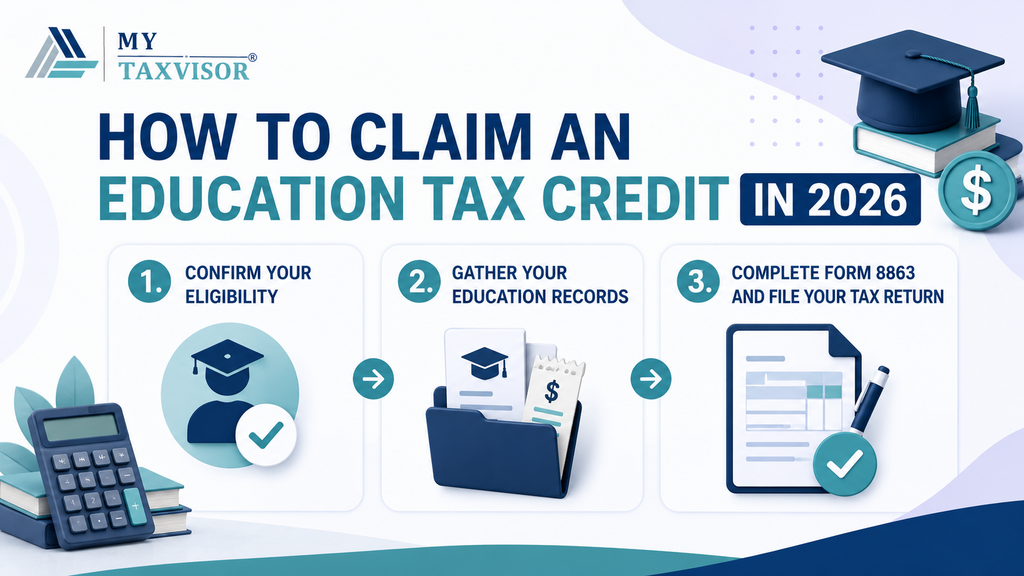
Claiming a credit involves confirming eligibility, documenting expenses, and filing the required form.
1. Confirm Your Eligibility
Check the student’s enrollment, prior AOTC claims, your filing status, and your MAGI. If you have multiple students, assess each student’s eligibility separately.
2. Gather Your Education Records
Collect:
- Form 1098-T from the educational institution.
- Tuition and fee receipts or account statements.
- Records of qualifying books, supplies, and equipment.
- Scholarship and grant information.
- The institution’s details, including its employer identification number where required.
Form 1098-T may not show every qualified expense, so retain receipts for additional costs you claim.
3. Complete Form 8863 and File Your Tax Return
Use IRS Form 8863 to calculate the credit and attach it to your federal income tax return, generally Form 1040 or Form 1040-SR.
The draft 2026 instructions also describe Social Security number requirements for education credits. Check the final instructions to confirm which taxpayers and students must meet these requirements before filing.
Common Education Tax Credit Mistakes to Avoid
Avoid these errors when preparing your return:
- Claiming both credits for one student: Only one of the two credits can be claimed for the same student in a tax year.
- Including ineligible expenses: Room, board, transportation, and personal costs generally do not qualify.
- Ignoring scholarships: Tax-free educational assistance may reduce eligible expenses.
- Misapplying dependent rules: Who can claim the student affects who may claim the credit.
- Overlooking income limits: Your MAGI can reduce or eliminate the credit.
- Relying only on Form 1098-T: Keep records of other eligible expenses.
- Missing identification requirements: Check the final 2026 IRS instructions.
- Claiming the AOTC too many times: The credit is limited to four tax years per student.
Review your records and eligibility before filing to reduce the risk of errors or delays.
What Is the Education Freedom Tax Credit Starting in 2027?
The Education Freedom Tax Credit is a separate federal tax benefit scheduled to begin on January 1, 2027. Under the announced framework, eligible individuals may claim a credit of up to $1,700 for qualifying cash contributions to eligible scholarship-granting organizations in participating states or jurisdictions.
This is not a credit for college tuition paid directly for yourself or your child in 2026. Eligibility depends on the program’s rules and whether the relevant state or jurisdiction participates.
Check the IRS Federal Scholarship Tax Credit page for updates.
Get Professional Help With Education Tax Credits in 2026
Claiming education tax credits requires careful review of eligibility rules, income limits, qualified expenses, and IRS requirements. Applying the correct rules helps you avoid errors and claim the credits available to you.
MyTaxVisor helps individuals and families with tax preparation and related tax requirements. Contact MyTaxVisor for professional support in reviewing your education expenses, assessing your eligibility, and preparing your federal tax return accurately.
Frequently Asked Questions About Education Tax Credits 2026
Can I claim an education tax credit if I paid my child’s tuition but do not claim them as a dependent?
Generally, you must claim the student as a dependent to claim a credit for their expenses. The student may claim a credit only if they meet the rules, including that no one else is entitled to claim them as a dependent.
What if my Form 1098-T shows less than I actually paid?
You may include additional qualified expenses if you can substantiate them with receipts or payment records and they meet the credit’s rules.
Can online college courses qualify for an education tax credit?
Yes. Online courses may qualify if the institution, student, and expenses meet the relevant requirements.
Can I claim a credit if my scholarship covers part of my tuition?
Yes, potentially. You may claim eligible expenses not covered by tax-free assistance, but you cannot use the same expenses for both a tax-free benefit and a credit.
Can I claim an education tax credit if I am married filing separately?
No. Married taxpayers filing separately cannot claim the AOTC or LLC.
Can I claim an education tax credit if I only paid student loan interest?
No. Student loan interest does not qualify for the AOTC or LLC. You may qualify for a separate student loan interest deduction, subject to its own rules.